Product Introduction
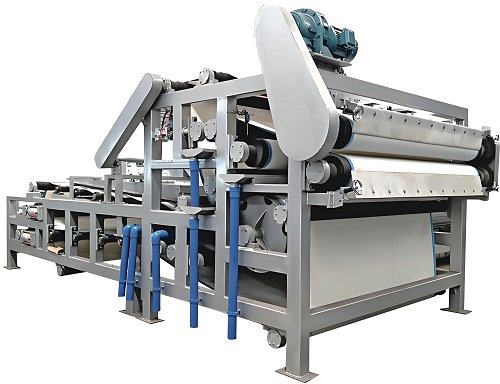
Its main body consists of a frame, a filter belt, a driving device, pressing rollers, a tensioning device and a matching cleaning system. The filter belt is usually made of materials with high strength, good corrosion resistance and excellent water permeability. As a key component for carrying and filtering sludge, the driving device provides power for the operation of the whole equipment to ensure the stable and uniform operation of the filter belt. There are multiple pressing rollers with a clever layout. Through different pressure combinations, the sludge is gradually compacted. The tensioning device ensures that the filter belt is always in a proper tension state to avoid problems such as slipping. The cleaning system can regularly clean the filter belt and related components to prevent the influence of sludge residue on the performance of the equipment. With these carefully designed components, it can efficiently handle various types of sludge and plays an important role in many sludge treatment projects.
Working Principle
Firstly, the sludge is transported to the starting end of the filter belt through the feeding device. During the slow movement of the filter belt, the initial sludge thickening is achieved by utilizing the effect of gravity and the water permeability of the filter belt itself. Part of the water begins to seep out and flows into the lower water collection tank through the pores of the filter belt and is then collected and discharged.
As the filter belt continues to operate, the sludge is brought to the pressing area. Here, multiple pressing rollers are arranged in sequence, and the distance between adjacent pressing rollers gradually decreases while the pressure gradually increases. When the sludge passes through the pressing rollers one by one, it is subjected to the continuously increasing squeezing force, and the water in it is further squeezed out. The moisture content of the sludge continues to decrease, and its volume is also constantly reduced. Finally, after multiple pressing processes, the dried sludge with a significantly reduced moisture content is discharged from the end of the filter belt, completing the whole process of sludge thickening, pressing and drying, and obtaining the dried sludge that is convenient for subsequent transportation and disposal.
Product Features
(I) High-efficiency Thickening and Pressing
It has excellent processing ability for sludge. It can reduce the moisture content of sludge with a relatively high initial moisture content (the initial moisture content can be about 90% – 98%) to about 60% – 80% after thickening and pressing, which greatly reduces the volume and weight of the sludge and lowers the cost of subsequent sludge transportation and disposal.
(II) Stable and Reliable Operation
The components of the equipment are closely coordinated, and its structural design is mature. Moreover, it adopts high-quality materials and advanced manufacturing processes. As long as the daily maintenance and operation are carried out in accordance with the specifications, it can operate stably for a long time, reducing the downtime caused by equipment failures and ensuring the continuity of sludge treatment work.
(III) Simple and Convenient Operation
The operation interface is clear and intuitive. Operators only need to undergo simple training to master basic operations such as starting, stopping, adjusting the running speed and adjusting the pressing pressure of the equipment. Moreover, the daily maintenance work mainly focuses on checking the wear of components, cleaning the filter belt and maintaining the lubrication system, without the need for complex professional skills and cumbersome operation procedures.
(IV) Energy Saving and Environmental Protection
During the operation process, it mainly relies on the motor to drive the operation of the filter belt and the work of the pressing rollers, and its energy consumption is relatively low. Meanwhile, through efficient thickening and pressing, it reduces the additional energy consumption required for subsequent sludge treatment links due to high moisture content, such as the heat energy required for drying, achieving the goal of energy saving and environmental protection as a whole.
(V) Strong Adaptability
It can handle sludge of different natures and sources. Whether it is the surplus sludge produced by urban sewage treatment plants, the sludge after industrial wastewater treatment, or the silt produced by river dredging, good thickening and pressing effects can be achieved by adjusting the corresponding operating parameters, with strong versatility.
Application Fields
(I) Municipal Sewage Treatment Industry
In urban sewage treatment plants, a large amount of surplus sludge is produced every day. The belt-type sludge thickening, pressing and drying integrated machine can efficiently handle this sludge, reducing its moisture content to an appropriate level, which is convenient for subsequent disposal methods such as landfill, incineration or resource utilization of the sludge, relieving the pressure of sludge treatment in sewage treatment plants and also meeting environmental protection requirements.
(II) Industrial Wastewater Treatment Field
Many industrial enterprises will leave sludge after treating the wastewater generated during the production process. For example, in industries such as papermaking, printing and dyeing, and chemical industry, the sludge in these industries has a complex composition and high moisture content. This drying machine can specifically handle it, reducing the amount of sludge and lowering the potential harm to the environment, ensuring the normal production and operation of enterprises and meeting environmental protection standards.
(III) River Regulation and Dredging Projects
During the process of river dredging, a large amount of silt will be dug out. The belt-type sludge thickening, pressing and drying integrated machine can quickly thicken and press these silts to make them in a state that is easy to transport and dispose of, facilitating the subsequent reasonable disposal of the silts, such as using them for land reclamation or making fertilizers, helping the smooth progress of river regulation work.
(IV) Wastewater Treatment in Livestock Farms
The wastewater in livestock farms contains a large amount of sludge formed by feces and sundries. After being treated by this drying machine, the moisture content of the sludge can be reduced, the odor emission can be reduced, and it is convenient for subsequent resource utilization such as composting of the sludge, realizing the effective treatment of the waste in livestock farms and improving the environmental quality around the farms.
Conclusion
The belt-type sludge thickening, pressing and drying integrated machine demonstrates powerful advantages in sludge treatment with its reasonable structural design, efficient working principle, excellent performance characteristics and wide application fields. It can no t only effectively solve the sludge treatment problems in different industries, reduce the moisture content and volume of the sludge, and facilitate the subsequent transportation and disposal, but also reduce the use cost and management difficulty through its advantages such as simple operation and energy saving and environmental protection. With the increasingly strict environmental protection requirements and the growing emphasis on the resource utilization of sludge, the belt-type sludge thickening, pressing and drying integrated machine will surely be deeply applied in more fields and continue to contribute to improving environmental quality and promoting green development.If you are interested in this product or have any questions, please feel free to contact us at any time.