Introduction
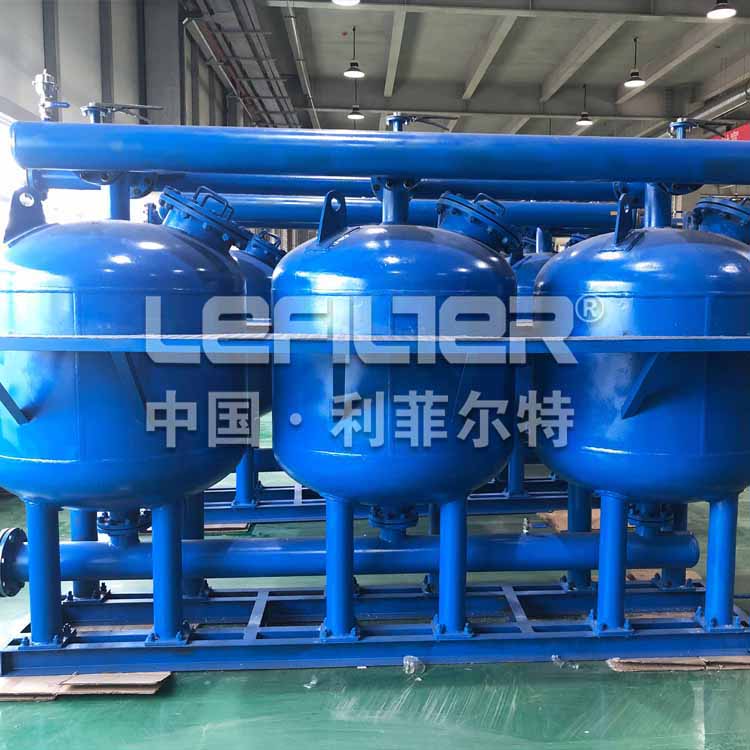
Shallow sand and industrial sand media filters are essential equipment in water treatment, designed to remove suspended solids, sediments, and particulate matter from various water sources. Unlike deep-bed filters, shallow sand filters feature a relatively thin layer of sand media, typically 15-30 cm, making them compact and efficient for specific applications. Industrial sand media filters, often tailored for heavy-duty use, utilize high-quality industrial-grade sand to handle larger volumes and harsher contaminants in industrial settings.
These filters play a crucial role in pre-treatment processes, protecting downstream equipment like pumps, heat exchangers, and membranes from fouling and damage. They are widely adopted across industries due to their simplicity, cost-effectiveness, and reliability in maintaining water quality.
Advantages & Features
2.1 Compact Design
Their shallow media layer results in a smaller footprint, saving space in installation areas. This makes them ideal for facilities with limited space, such as small factories, commercial buildings, or mobile treatment units.
2.2 Quick Backwashing
Shallow sand filters require shorter backwash cycles compared to deep-bed filters. The thin media layer allows for faster removal of accumulated contaminants, reducing downtime and ensuring continuous operation. Industrial variants often have automated backwash systems for added efficiency.
2.3 Cost-Effective
The use of sand as the primary media, which is abundant and affordable, lowers initial and replacement costs. Additionally, their simple structure minimizes maintenance expenses, making them a budget-friendly choice for many applications.
2.4 High Flow Rates
Industrial sand media filters are engineered to handle high flow rates, suitable for large-scale industrial processes. They efficiently process large volumes of water without significant pressure drops, ensuring consistent performance.
2.5 Versatile Media Options
While sand is the main media, these filters can incorporate other materials like anthracite or gravel in layered configurations to enhance filtration efficiency for specific contaminants, such as finer particles or organic matter.
Structure Specification
3.1 Filter Vessel
Constructed from materials like carbon steel (with epoxy coating), stainless steel, or fiberglass, the vessel houses the media. It comes in vertical or horizontal designs, with sizes varying based on flow rate requirements. Industrial models often have reinforced walls to withstand high pressures.
3.2 Sand Media
Shallow filters use fine to medium sand (0.4-1.2 mm in diameter) for effective particle capture. Industrial sand is specially graded for durability and uniformity, resisting breakdown under harsh conditions. The media layer thickness ranges from 15 cm for shallow filters to 30 cm in some industrial models.
3.3 Support Layer
Beneath the sand, a layer of gravel (2-10 mm) provides support, preventing sand from escaping during filtration and backwashing. It also helps distribute water evenly across the bed.
3.4 Distribution/Collection Systems
Inlet distributors (perforated pipes or diffusers) spread water evenly over the media surface. Outlet collectors (underdrains) at the bottom gather filtered water, featuring slots or nozzles to retain sand while allowing water passage.
3.5 Control System
Includes valves for filtration and backwashing. Industrial filters may have automated PLC systems to monitor pressure differentials and trigger backwashing.

Working Principle
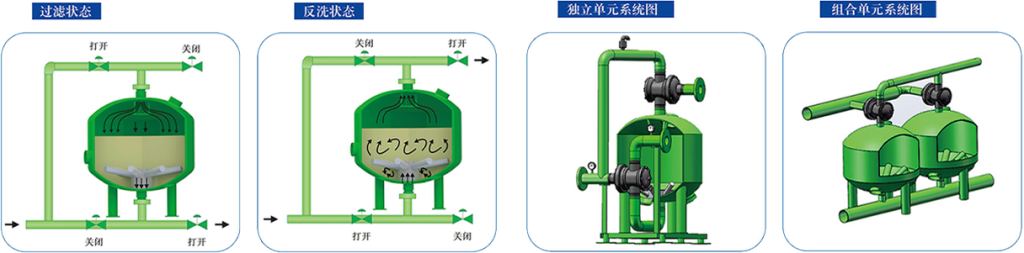
During filtration, water enters the vessel and flows downward through the sand media. Suspended particles are trapped by mechanical straining, adsorption, and interception within the sand pores. The filtered water passes through the support layer and is collected by the underdrain system for discharge.
As contaminants accumulate, the pressure differential across the filter increases. When it reaches a set threshold (typically 0.5-1.0 bar), backwashing is initiated. Backwash water flows upward through the media, expanding the sand bed and dislodging trapped particles. The dirty water is flushed out through a waste valve. After backwashing, a rinse cycle settles the media, and filtration resumes.
Application
5.1 Industrial Pre-Treatment
Used in manufacturing, power plants, and refineries to pre-treat raw water before it enters boilers, cooling towers, or process lines, preventing scale and equipment damage.
5.2 Municipal Water Treatment
Applied in small to medium-sized water plants for removing turbidity and sediments from surface water or groundwater, improving water clarity before disinfection.
5.3 Commercial Facilities
Installed in hotels, shopping malls, and hospitals to treat water for HVAC systems, swimming pools, and general use, ensuring clean water supply.
5.4 Agriculture and Irrigation
Filters irrigation water to remove sand, silt, and debris, protecting drip systems and sprinklers from clogging, and enhancing crop yield.
5.5 Wastewater Treatment
Used as a primary treatment step in industrial wastewater processing to reduce suspended solids before further treatment, easing the load on downstream processes.