Introduction
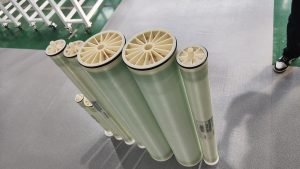
The equivalent BW30HR-440I brackish water RO membranes lower the cost of desalination by improving energy efficiency and productivity. These thin-film nanocomposite (TFN) membranes feature benign nanomaterials incorporated into the thin-film polyamide layer of a composite membrane. This innovative patented and patent-pending technology significantly increases membrane permeability while offering superior salt rejection.
- Matches industry-standard flux and rejection
- Easy to retrofit existing systems
- Well suited for low quality feed water or varying operating conditions.
Product Type
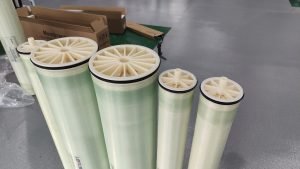
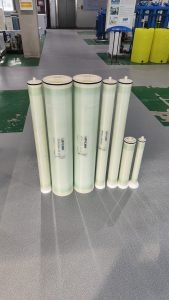
Spiral-wound element with polyamide thin-film nanocomposite membrane
Typical Properties
Active area: 400ft2 (37m2)
Feed spacer thickness: 34mil
Permeate flow rate: 10500gpd (39.7m3/d)
Stabilized salt rejection: 99.6%
Minimum salt rejection: 99.5%
| Notes: Permeate flow and salt rejection based on the following standard conditions: 2,000 ppm NaCl, 225 psi (15.5 bar), 77°F (25°C), pH 7 and 15% recovery. |
Dimensions
Inner diameter: 1.125inch (28.6mm)
Outer diameter: 7.9inch (201mm)
Length: 40.0inch (1016mm)
Suggested Operating Conditions
Maximum Operating Temperature: 113°F (45°C)
Maximum Operating Pressure: 600 psig (41 bar)
Maximum Pressure Drop: 15 psig (1.0 bar)
pH Range: Continuous Operation: 2 – 11
Short-Term Cleaning (30 min.): 2 – 12
Maximum Feed Flow: 75 gpm (17 m3/hr)
Maximum Feed Silt Density Index: SDI 5
Free Chlorine Tolerance: < 0.1 ppm
Max. Feedwater Turbidity: 1.0 NTU
Important Information
Proper start-up of reverse osmosis water treatment systems is essential to prepare the membranes for operating service and to prevent membrane damage due to overfeeding or hydraulic shock. Following the proper start-up sequence also helps ensure that system operating parameters conform to design specifications so that system water quality and productivity goals can be achieved.
Before initiating system start-up procedures, membrane pretreatment, loading of the membrane elements, instrument calibration and other system checks should be completed.
Operation Guidelines
Avoid any abrupt pressure or cross-flow variations on the spiral elements during startup, shutdown, cleaning or other sequences to prevent possible membrane damage.
During start-up, a gradual change from a standstill to operating state is recommended as follows:
- Feed pressure should be increased gradually over a 30-60 second time frame.
- Cross-flow velocity at set operating point should be achieved gradually over 15-20 seconds.
General Information
- Keep elements moist at all times after initial wetting.
- To prevent biological growth during prolonged system shutdowns, it isrecommended that membrane elements be immersed in a preservative solution.
- The customer is fully responsible for the effects of incompatible chemicals andlubricants on elements.
- Maximum pressure drop across an entire pressure vessel (housing) is 50 psi (3.4bar).
- Avoid static permeate-side backpressure at all times.