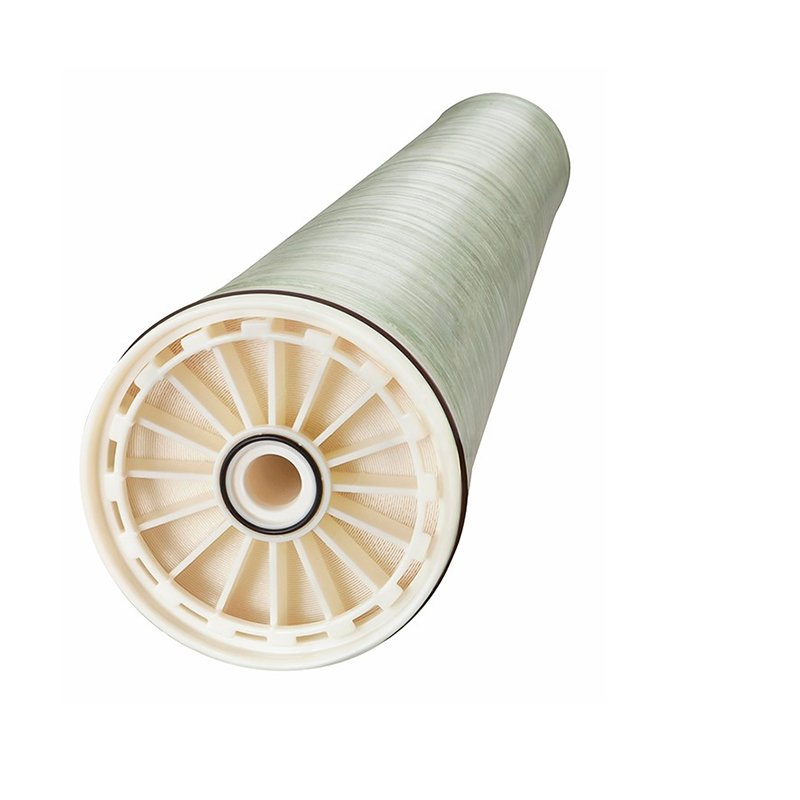
Product Introduction
- The pore size range of the ultrafiltration membrane is 0.01 – 0.1μm, made of polymer materials such as PVDF and PES.
- It can separate and intercept macromolecular substances such as colloids, proteins, and microorganisms in water, while retaining beneficial minerals.
- Widely used in industrial pretreatment, drinking water purification, and other fields.
Working Process
- Raw Water Inflow: The raw water flows into the ultrafiltration membrane module through the pipeline.
- Pressure Filtration: Under a pressure of 0.1 – 0.3MPa, small molecular substances pass through the membrane pores, and macromolecular impurities are retained.
- Product Water Discharge: The filtered product water enters subsequent treatment or is used directly.
- Backwashing: Regular backwashing is carried out to remove pollutants on the membrane surface and restore the filtration performance.
Product Features
- High – flux Design: The water production per unit area is 20% higher than that of traditional membranes.
- Anti – fouling Performance: Hydrophilic membrane materials reduce the adsorption of organic substances.
- Long Service Life: Under normal use, the service life can reach 3 – 5 years.
- Environmentally Friendly and Energy – saving: No chemical agents are required, and low – pressure operation reduces energy consumption.
Technical Parameters
| Item | Parameter Range |
|---|---|
| Membrane Material | PVDF, PES, etc. |
| Filtration Precision | 0.01 – 0.1μm |
| Working Pressure | 0.1 – 0.3MPa |
| Working Temperature | 5 – 45℃ |
| Single Membrane Area | 4 – 60㎡ |
Application Areas
- Drinking Water Treatment: Advanced purification in waterworks.
- Food and Beverage: Juice clarification and wine filtration.
- Industrial Water: Treatment of process water in textile dyeing and papermaking industries.
- Biological Engineering: Separation of fermentation broth and purification of enzyme preparations.
FAQ
Question 1: How to determine the backwashing frequency of the ultrafiltration membrane?
Answer: The backwashing frequency is determined according to the raw water quality and operating time. Generally, a short – time backwashing is carried out every 1 – 2 hours, and a long – time chemical enhanced backwashing is carried out 1 – 2 times a day.
Question 2: Can the ultrafiltration membrane remove heavy metal ions in water?
Answer: The ultrafiltration membrane mainly intercepts macromolecular substances and has limited effect on the removal of heavy metal ions. It is necessary to combine processes such as ion exchange resins and reverse osmosis for further treatment.
Answer: The backwashing frequency is determined according to the raw water quality and operating time. Generally, a short – time backwashing is carried out every 1 – 2 hours, and a long – time chemical enhanced backwashing is carried out 1 – 2 times a day.
Question 2: Can the ultrafiltration membrane remove heavy metal ions in water?
Answer: The ultrafiltration membrane mainly intercepts macromolecular substances and has limited effect on the removal of heavy metal ions. It is necessary to combine processes such as ion exchange resins and reverse osmosis for further treatment.
Conclusion
With its precise separation ability and high – flux filtration advantages, the efficient ultrafiltration membrane has become an important technical means in the water treatment field, providing stable and reliable water quality guarantee solutions for different industries.
Related Products