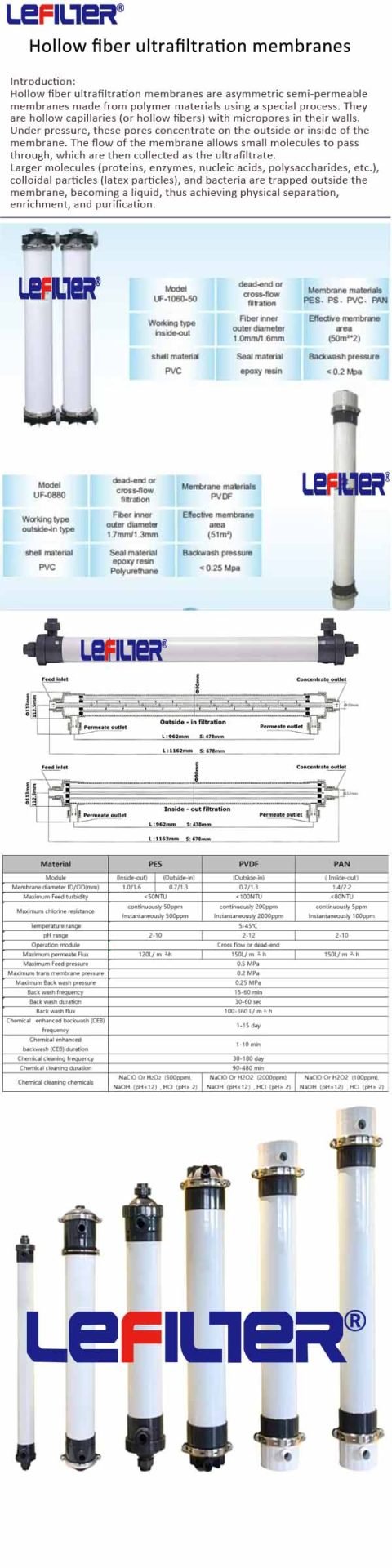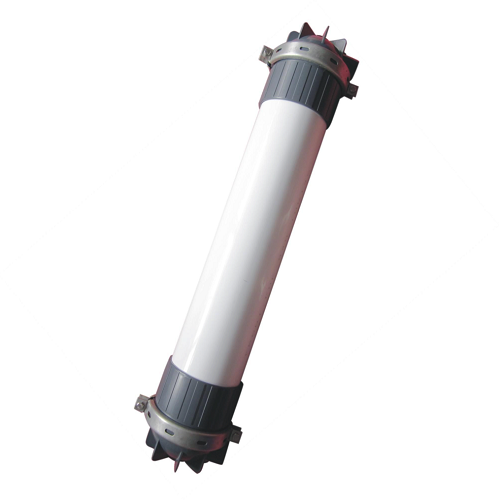
Ultrafiltration membrane modules are pressure-driven, sieving-based core separation devices that can efficiently retain colloids, bacteria, and macromolecular organic matter. They are widely used in municipal, industrial, food, pharmaceutical, and electronics industries.
Ultrafiltration Membrane Module Introduction
1. Basic Principles and Parameters
Technology Positioning: A membrane separation technology between microfiltration (MF) and nanofiltration (NF), its core is physical sieving.
Pore Size Range: 0.01–0.1 μm (10–100 nm), Molecular Weight Cut-off: 1,000–500,000 Da.
Driving Pressure: 0.1–0.5 MPa (Low-pressure operation, energy consumption far lower than reverse osmosis (RO)).
Separation Effect: 100% removal of bacteria, most viruses, colloids, suspended solids, and large organic molecules; allows water molecules, ions, and small solute molecules to pass through.
2. Mainstream structural types
| Types | Structural features | Applications |
| Hollow fiber type | Outer diameter 0.5–2.0 mm, no support, extremely high packing density. | Municipal water supply, household water purification, industrial pure water pretreatment |
| Roll type | Diaphragm + flow guide mesh spirally wound around the central tube. | Low turbidity industrial water, RO pretreatment |
| Flat type | Diaphragm sandwiched within the flow guide mesh, modular design. | Specialty separation, MBR, highly polluted wastewater |
| Tube type | Membrane liner inside the tube, inner diameter > 10 mm. | High solids content, high viscosity feed solutions |
3. Commonly Used Membrane Materials
Polyvinylidene fluoride (PVDF): The most mainstream material; acid and alkali resistant, oxidation resistant, fouling resistant, and high strength.
Polyethersulfone (PES): Good hydrophilicity, high flux, and temperature resistant.
Polysulfone (PS): Good chemical stability and high mechanical strength.
Cellulose acetate (CA): Good hydrophilicity and low cost, but poor chemical resistance.
4. Core Advantages
Low Pressure and Energy Saving: Pressure is only 1/10–1/5 of RO, resulting in low operating costs.
Room Temperature Operation: No phase change or heating, protecting heat-sensitive substances (such as enzymes, proteins, and vitamins).
Physical Separation: No chemical reagents added, no secondary pollution, and stable effluent.
Modular Integration: Small footprint, easy to expand, and highly automated.
Main Application Industries and Scenarios
1. Municipal and Drinking Water
* Deep water treatment in waterworks: Replaces sand filtration + disinfection, removes turbidity, bacteria, viruses, and colloids, resulting in directly drinkable water.
* Rural/Decentralized Water Supply: Solves problems of micro-pollution, high turbidity, and excessive microorganisms.
* Emergency Water Purification: Rapid water production for disaster relief, field use, and ships.
2. Industrial Water Treatment and Reuse
* Power/Metallurgy: Cooling circulating water purification and reuse, boiler feedwater pretreatment, zero wastewater discharge.
* Petrochemical/Chemical: Oily wastewater treatment, chemical feedstock separation, wastewater reuse (UF+RO combination accounts for 67%).
* Textile/Dyeing: Dyeing wastewater decolorization and reuse, reducing COD and salinity.
* Papermaking: White water recovery, fiber retention, water conservation and emission reduction.
MBR (Membrane Bioreactor): Advanced treatment of municipal/industrial wastewater, effluent SS≈0, directly reusable.
3. Other Applications
Seawater/Brackish Water Desalination: RO pretreatment, extending RO membrane life and reducing fouling.
Swimming Pool/SPA Circulating Water: Continuous sterilization and turbidity removal, reducing disinfectant usage.
Car Wash/Greywater Reuse: Wastewater is purified and recycled, saving over 80% of water.