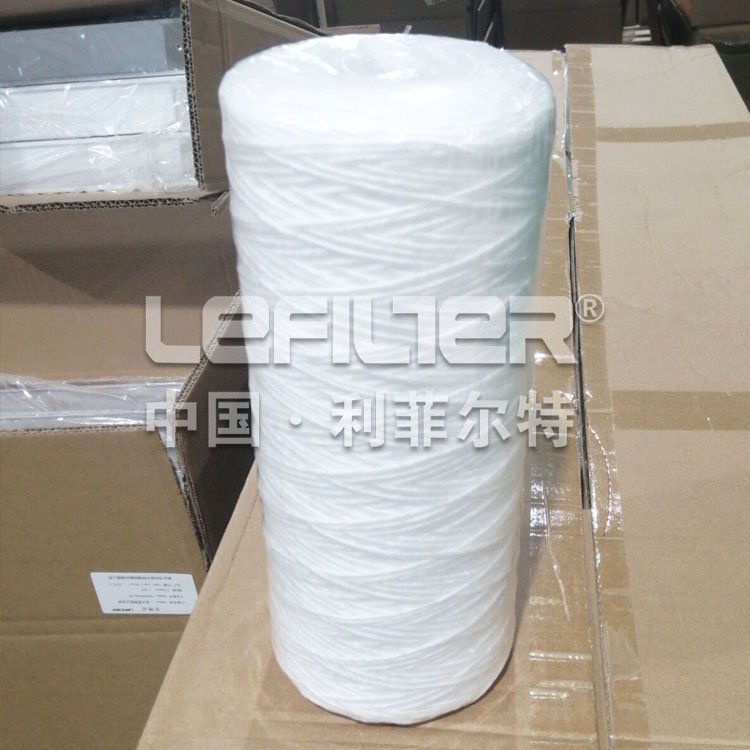
String Wound Filter Cartridge: Deep Filtration Solution for Multi-Industry Fluid Purification

String Wound Filter Cartridge: Deep Filtration Solution for Multi-Industry Fluid Purification

Introduction

The String Wound Filter Cartridge is a core deep filtration component engineered to remove suspended solids, particles, scales, and microorganisms from low-viscosity, low-impurity fluids. It is manufactured by precisely winding textile fibers (such as polypropylene thread or  cotton thread) onto a porous skeleton (made of polypropylene or stainless steel), featuring a honeycomb structure with a loose exterior and dense interior. This unique structure ensures efficient impurity interception while maintaining stable fluid flow.

High-Temperature String Wound Filter Cartridge: Enduring Purity for Hot Fluid Processing

Core Features: Precision, Durability, and Safety

① Ultra-Precise Filtration Performance
  • High Interception Efficiency: Boasts a retention rate exceeding 90% for target particles, with a filtration precision range from 1μm to 100μm—customizable to meet specific application demands (e.g., 1μm for electronics, 50μm for general industrial use).

  • Deep Filtration Mechanism: The outer-loose-inner-dense structure first traps large particles, then captures finer contaminants in deeper layers, minimizing pressure drop while maximizing dirt-holding capacity.

② Robust Flow & Reusability
  • Enhanced Pressure Resistance: The inner-threaded design bolsters structural integrity, withstanding operating pressures up to 0.5MPa and pressure differentials ≤0.2MPa.

  • Washable & Cost-Effective: Compatible with chemical cleaning, steam sterilization, or online regeneration—extending service life and slashing replacement costs by up to 40%.

③ Food-Grade Material Compliance

Safe for Sensitive Sectors: All components adhere to food-grade standards:

    • Filter media: Polypropylene (PP) fiber, absorbent cotton, or glass fiber.

    • Supports & structure: Polypropylene (PP).

    • Seals: Silicone rubber, NBR, EPDM, or fluororubber—ensuring chemical compatibility across a pH range of 2–12.

④ Optimized Honeycomb Structure
  • Large Dirt-Holding Capacity: The outer-loose-inner-dense winding pattern creates ample “pore storage” space, increasing contaminant retention by 30–50% compared to standard cartridges—delaying clogging and extending maintenance intervals.

_MG_0383

Technical Specifications: Tailored to Diverse Needs

ParameterDetails
Core SkeletonPolypropylene (PP) or stainless steel
Outer DiameterΦ60mm, Φ65mm
Inner DiameterΦ28mm, Φ30mm
Length10”, 20”, 30”, 40” (customizable)
Operating Pressure≤0.5MPa
Max Pressure Drop≤0.2MPa
Temperature Limit– Polypropylene fiber + PP skeleton: ≤60℃
– Polypropylene fiber + stainless steel skeleton: ≤80℃
– Absorbent cotton + stainless steel skeleton: ≤120℃
Filtration MediaPP fiber, absorbent cotton, glass fiber
Filtration Precision1μm, 5μm, 10μm, 20μm, 30μm, 50μm, 75μm, 100μm (customizable)

Working Principle: Layer-by-Layer Contamination Trapping

The string wound filter cartridge’s filtration efficiency arises from its dual-design advantage:

  1. Controlled Winding Density: Textile fibers (e.g., PP, absorbent cotton) are wound onto the skeleton with increasing tightness from the outer to the inner layer. This forms a pore-size gradient—larger surface pores intercept coarse particles, while smaller inner pores capture fine contaminants.

  2. Deep Filtration Path: As fluid flows through the cartridge, contaminants are trapped not only on the surface but also within the layered fiber structure (honeycomb-like), maximizing dirt-holding capacity. This “depth filtration” reduces pressure drop and extends service life compared to surface-only filters.

_MG_4846

Application Fields: Ensuring Purity Across Industries

① Pharmaceutical Industry
  1. Use Case: Pre-filtration in water-for-injection (WFI) systems, removing particles and bacteria to meet USP <1231> standards.

  2. Case: A Shanghai pharmaceutical plant reduced endotoxin levels from 0.5EU/ml to <0.25EU/ml using 5μm PP-wound cartridges, ensuring batch consistency.

② Food & Beverage Industry
  1. Use Case: Filtration of process water, juices, and syrups to eliminate suspended solids, mold, and yeast.

  2. Data: A Zhejiang beverage factory achieved a turbidity of NTU <1 in product water using 10μm absorbent cotton-wound cartridges, extending shelf life by 20%.

③ Electronics Industry
  1. Use Case: Ultra-pure water (UPW) preparation for semiconductor manufacturing, removing particles ≥1μm.

  2. Practice: A Guangdong electronics fab uses 1μm glass fiber-wound cartridges in RO pre-treatment, cutting UPW system downtime by 35%.

④ Petrochemical & Lubrication Industry
  1. Use Case: Filtration of lubricating oils and hydraulic fluids to remove wear particles and oxidation byproducts.

  2. Result: A Shandong steel mill extended hydraulic oil change intervals from 6 months to 12 months using 20μm PP-wound cartridges, reducing maintenance costs by ¥200,000 annually.

_MG_4850

Q&A: Addressing Key Customer Queries

Q1: How do I select the right filtration precision?
A1: Align precision with your fluid’s purity need.

Electronics/Pharma: 1–10μm (removes fine particles).

Food/Beverage: 10–50μm (removes suspended solids).

Industrial Lubrication: 20–100μm (removes wear debris).

Q2: Can the cartridge be cleaned and reused?
A2: Yes! For non-abrasive contaminants, clean via:

  1. Water backflushing (for particles).

  2. Chemical soaking (e.g., 5% citric acid for scale, 1% NaOH for organics).

  3. Steam sterilization (for food/pharma applications).

Q3: What’s the temperature limit for my application?
A3: It depends on the media and skeleton:

  1. PP fiber + PP skeleton: ≤60℃ (ideal for general water).

  2. PP fiber + stainless steel: ≤80℃ (for warm fluids).

  3. Absorbent cotton + stainless steel: ≤120℃ (for hot water/steam use).

Q4: Are the materials safe for food contact?
A4: Absolutely—all components (PP, absorbent cotton, food-grade rubbers) comply with FDA 21 CFR §177 and EU 10/2011 regulations, making them safe for food/beverage applications.

Q5: How long does a cartridge last?
A5: Lifespan varies by application:

  1. Clean water (e.g., RO pre-treatment): 6–12 months.

  2. Oily fluids (e.g., lubricants): 3–6 months.

  3. Monitor pressure drop—replace when it exceeds 0.2MPa.

If you are interested in this product or have any questions, please feel free to contact us at any time.

Scroll to Top