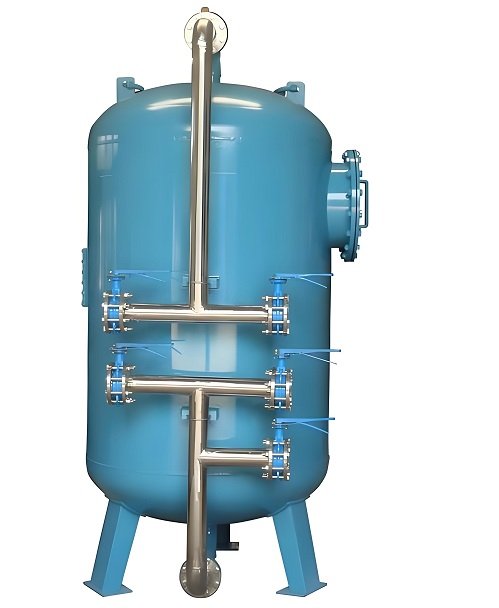
Product Introduction
The manganese sand filter is a specialized water treatment device engineered to address iron and manganese contamination, leveraging the unique catalytic properties of manganese-rich media. Operating on the principle of catalytic oxidation and adsorption, this filter transforms soluble ferrous (Fe²⁺) and manganous (Mn²⁺) ions into insoluble precipitates, which are then trapped within the filter bed. As water flows through a bed of manganese sand, the active manganese dioxide (MnO₂) components catalyze reactions that convert these metals into ferric hydroxide and manganese oxides, effectively purifying the water. This process is vital for applications where iron and manganese can cause discoloration, corrosion, or health risks—such as domestic water supply, industrial processes, and environmental remediation.
Working Principle
- Adsorption and Filtration
The porous structure of manganese sand provides a large surface area for adsorbing oxidized metal compounds. As precipitates accumulate, they form a “filter cake” that enhances mechanical filtration, trapping even fine particles. This dual mechanism of catalytic oxidation and physical adsorption ensures high-efficiency contaminant removal, even at low oxygen concentrations.
- Backwashing and Regeneration
Over time, the filter bed accumulates precipitates, increasing pressure drop. Backwashing with high-velocity water (15–25 m/h) dislodges these solids. In cases where manganese sand activity declines, regeneration with an oxidant like potassium permanganate can reactivate the media by restoring its catalytic surface.
Structural Design and Components
- Filter Vessel
Constructed from stainless steel, fiberglass, or concrete, the vessel withstands water pressure and corrosion. Key features include:
– Inlet/outlet pipes for water flow.
– Pressure gauges to monitor bed clogging.
– Backwash ports for regeneration.
– Inspection hatches for media maintenance.
- Manganese Sand Media
The filter bed consists of 0.6–1.2 mm manganese sand particles, chosen for optimal flow and contact time. A support layer of gravel or anthracite below the sand prevents media displacement during backwashing. The sand’s manganese content directly influences its oxidation efficiency, with higher MnO₂ levels enhancing performance.
- Flow Distribution System
Perforated plates or diffusers at the inlet and outlet ensure uniform water distribution, preventing channeling. This design maximizes contact between water and manganese sand, ensuring consistent oxidation and adsorption.
- Backwash System
Comprising a pump, control valves, and flow regulators, this system reverses water flow to clean the bed. Advanced systems may combine water backwashing with air scouring to improve solids removal efficiency.
Application Scenarios
- Domestic Water Treatment
In areas with iron/manganese-rich groundwater, manganese sand filters:
– Eliminate “red water” and metallic tastes caused by iron.
– Reduce manganese to below 0.05 mg/L, meeting WHO drinking water standards.
– Prevent staining of fixtures and laundry, improving water usability.
- Industrial Process Water
In power plants and manufacturing facilities, the filter:
– Prevents scaling in boilers and heat exchangers by removing iron/manganese, which accelerate corrosion.
– Ensures high-purity water for semiconductor production, where trace metals compromise product quality.
– Reduces maintenance costs by extending equipment lifespan.
- Agriculture and Aquaculture
For irrigation and fish farming, the filter:
– Mitigates iron/manganese toxicity to crops and aquatic life.
– Maintains water clarity, reducing the need for chemical treatments and improving ecosystem health.
Technical Advantages
- High Efficiency
Capable of removing iron from 10 mg/L to <0.3 mg/L and manganese from 5 mg/L to <0.1 mg/L, exceeding most regulatory requirements.
- Cost-Effectiveness
Requires minimal chemical input (only during regeneration) and low energy consumption, making it economical for long-term use.
- Longevity
Manganese sand can operate for 5–8 years with proper maintenance, reducing replacement costs compared to other filtration media.
- Adaptability
Adjustable parameters (bed depth, flow rate, backwash frequency) allow customization for varying water qualities, from groundwater to industrial wastewater.
Maintenance and Operation Considerations
- Performance Monitoring
– Regularly test treated water for iron/manganese levels using online analyzers or manual sampling.
– Monitor pressure drop; initiate backwashing when it reaches 1.5–2 bar to avoid efficiency loss.
- Backwash Optimization
– Adjust backwash flow and duration based on water quality: higher loads require longer, higher-velocity backwashes.
– Verify backwash effluent clarity to ensure complete solids removal.
- Media Management
– Replace manganese sand if removal efficiency declines despite proper backwashing.
– Inspect for compaction or particle degradation, which reduce catalytic surface area.
- System Integration
– Pair with pre-filtration (e.g., multimedia filters) to remove large particles.
– Use post-treatment (e.g., activated carbon) for organic matter in complex water sources.
Conclusion
The manganese sand filter serves as a cornerstone in water treatment, offering a robust solution for iron and manganese control. Its ability to combine catalytic oxidation with physical filtration makes it indispensable for industries and communities reliant on clean water. As global water demands grow, the filter’s efficiency and adaptability position it as a key technology in sustainable water management, ensuring both environmental protection and operational reliability. Future advancements—such as nano-engineered manganese media and intelligent backwash systems—will further enhance its performance, solidifying its role in addressing complex water quality challenges.
If you are interested in this product or have any questions, please feel free to contact us at any time.