Introduce:
In the field of water treatment, quartz sand filter is a widely used filtration equipment. It has become a key component in many water treatment systems due to its advantages of high efficiency, reliability, and low cost. This article will provide a detailed introduction to the working principle, structural characteristics, application areas, and maintenance of quartz sand filters.
Technical parameters:
Design filtration rate: 8-10 meters per hour.
Final head loss: 1.7 meters.
Anti cleaning intensity: 4-15 liters per second per square meter.
Inlet turbidity: less than 15 degrees, outlet turbidity less than 3 degrees; When the inlet turbidity is less than 10 degrees, the outlet turbidity is less than 2 degrees.
Inlet water pressure: ≥ 0.04MPa.
Backwash inlet water pressure: ≥ 0.15MPa.
Import and export pressure difference: 0.01-0.015MPa.
Filtration speed: 15-20m/h.
Operating cycle: 2-7 days.
Backwashing method: Water washing or a combination of air and water backwashing.
Backwash water consumption: 1-3%.
Backwash strength: 4-15L/s · m ².
Backwashing time: 5-7 minutes.
Backwash expansion rate: 40-50%.
working principle:
Quartz sand filters mainly use quartz sand as a filtering medium to remove suspended solids, particulate matter, and other impurities in water through physical filtration. When the water to be treated enters the filter layer from the upper part of the filter, impurities in the water are intercepted and adsorbed by quartz sand particles. As the filtration process progresses, impurities gradually accumulate in the quartz sand layer, forming a filter cake, thereby further improving the filtration effect. The filtered water flows out from the bottom of the filter to achieve purification.
The filtration accuracy of quartz sand filters depends on the particle size of quartz sand and the thickness of the filter layer. Generally speaking, the smaller the particle size of quartz sand, the higher the filtration accuracy, but it also increases the resistance of the filter and reduces the filtration flow rate. Therefore, in practical applications, it is necessary to select the appropriate quartz sand particle size and filter layer thickness based on specific water quality requirements and treatment flow rates.
Structural features:
1.Tank body
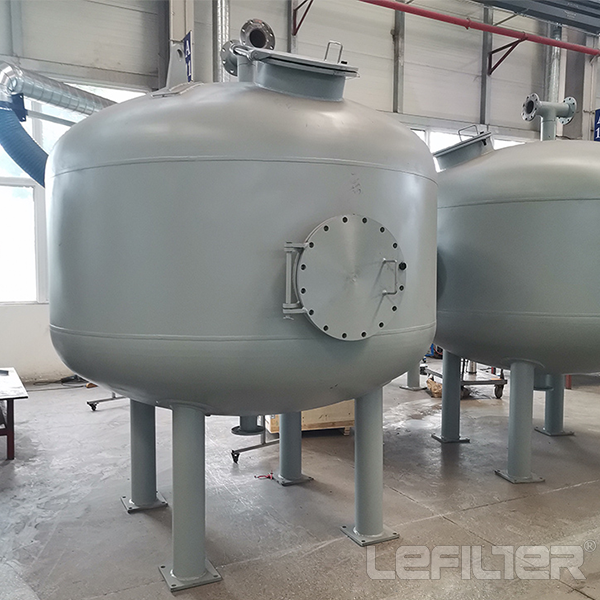
Quartz sand filters are usually composed of cylindrical tanks made of materials such as carbon steel, stainless steel, or fiberglass. The design of the tank should meet certain strength and sealing requirements to ensure that the filter does not leak during operation.
2.Water distribution system
The function of the water distribution system is to evenly distribute the water to be treated on the filter layer to improve filtration efficiency. Common water distribution methods include bell mouth water distribution, porous board water distribution, etc.
3.Filter layer
The filter layer is composed of quartz sand particles, and the particle size and grading of quartz sand should be selected according to water quality requirements and treatment flow rate. Generally speaking, the thickness of the filter layer is between 0.8-1.2 meters.
4.Water collection system
The water collection system is located at the bottom of the filter and is used to collect filtered water. Water collection systems usually use porous pipes or filter plates to ensure that water can flow out of the filter evenly.
5.Valves and instruments
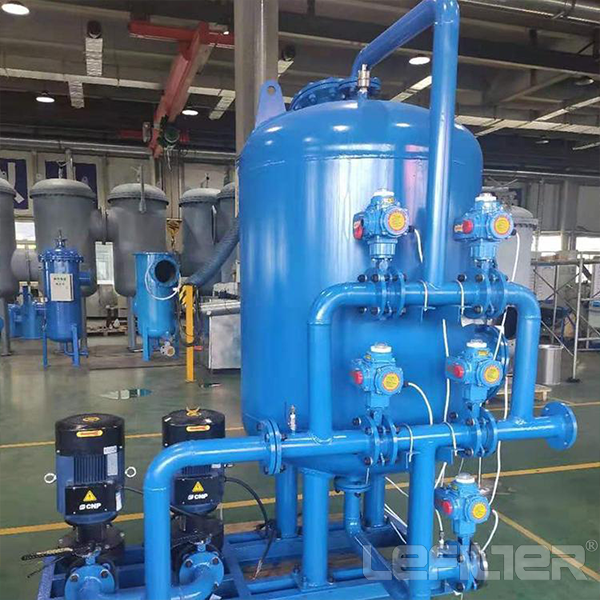
The quartz sand filter is also equipped with various valves and instruments, such as inlet valves, outlet valves, backwash valves, pressure gauges, flow meters, etc., to control the operation of the filter and monitor the filtration effect.

application area :
1.Drinking water treatment
Quartz sand filters can effectively remove suspended solids, sediment, rust and other impurities from water, improving the quality of drinking water. In drinking water treatment systems, quartz sand filters are usually used as pre-treatment equipment, in conjunction with activated carbon filters, ultrafiltration membranes, and other equipment.
2.Industrial water treatment
In industrial water treatment, quartz sand filters can be used to remove impurities from water and meet the water quality requirements of industrial production. For example, in industries such as electronics, chemicals, and pharmaceuticals, there are very high requirements for water quality. Quartz sand filters can effectively remove small particles and organic matter from water, ensuring smooth production processes.
3.sewage disposal
In the process of sewage treatment, quartz sand filters can be used as advanced treatment equipment to remove suspended solids and organic matter from sewage and improve the discharge standards of sewage. In addition, quartz sand filters can also be used in sewage reuse systems to further purify recycled water.
4.Swimming pool water treatment
Swimming pool water needs to be kept clean and transparent to ensure the health and safety of swimmers. Quartz sand filters can effectively remove suspended solids, organic matter, bacteria and other impurities from swimming pool water, maintaining the water quality of the swimming pool.
Maintenance and upkeep:
1.Regular backwashing
In order to maintain the filtering effect of the quartz sand filter, it is necessary to regularly backwash the filter. The frequency of backwashing depends on factors such as water quality and treatment flow rate, and is generally once a day or once a week. When backwashing, the backwash water enters from the bottom of the filter to loosen the quartz sand layer and flush out the impurities accumulated in the quartz sand layer. The backwash time is usually 10-15 minutes.
2.Replace quartz sand
When the filtering effect of the quartz sand filter decreases or the quartz sand particles are severely worn, the quartz sand needs to be replaced. The time interval for replacing quartz sand depends on factors such as water quality and treatment flow rate, and is generally 1-2 years.
3.Check valves and instruments
Regularly inspect the valves and instruments of the quartz sand filter to ensure their normal operation. If problems such as valve leakage or instrument malfunction are found, they should be repaired or replaced in a timely manner.
4.Clean the tank body
Regularly clean the tank body of the quartz sand filter to remove dirt and impurities from the inner wall of the tank body. The time interval for cleaning the tank depends on factors such as water quality and treatment flow rate, and is generally once a year.
Quartz sand filter is an efficient and reliable water treatment equipment with a wide range of application fields. It removes impurities from water through physical filtration, improves water quality, and provides guarantees for people’s lives and production. When using quartz sand filters, it is necessary to select appropriate equipment models and parameters based on specific water quality requirements and treatment flow rates, and regularly maintain them to ensure the normal operation and filtration effect of the filter.