Product Introduction
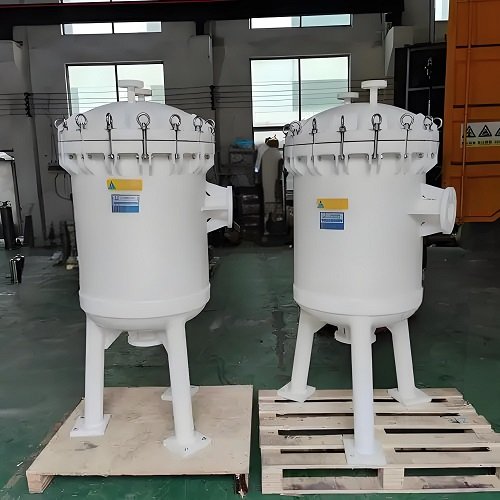
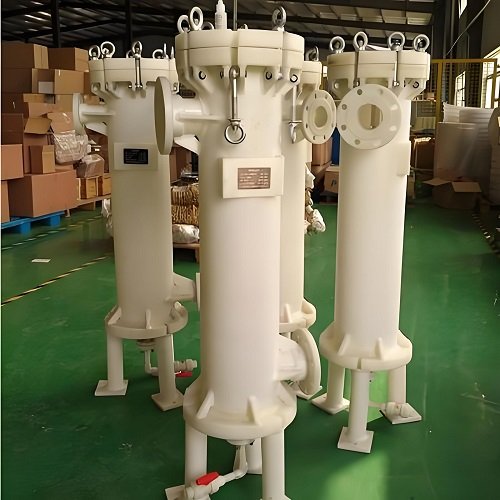
As a new generation of industrial filtration equipment, PP bag filters are gradually becoming the preferred solution for industries such as chemical engineering, water treatment, and food & beverage, thanks to their all-plastic integrated structure and excellent chemical compatibility. The core design concept focuses on “efficiency, durability, and easy maintenance”—using polypropylene (PP) for one-piece injection molding without welding points or dead corners, ensuring both equipment sealing and pressure resistance while withstanding long-term erosion from strong acids, alkalis, and organic solvents. Compared with traditional metal filters, PP bag filters excel in cost control, corrosion resistance, and lightweight design, making them particularly suitable for scenarios with strict hygiene requirements or highly corrosive media.
Core Technology and Structure Innovations
When in operation, the sludge first enters the thickening area of the equipment. Under the action of gravity and the preliminary filtration of the filter belts, the initial solid-liquid separation is achieved, and part of the water seeps through the filter belts and is discharged. Then, the sludge enters the pressing area. Through the pressure applied by multiple sets of pressing rollers, the sludge is further squeezed to squeeze out more water. Meanwhile, the sludge gradually forms a mud cake. Eventually, a relatively high solid content is achieved, and the mud cake is discharged from the end. The separated water flows out through the corresponding drainage ports, realizing the efficient drying treatment of the sludge.
Main Performance
- Optimized Filtration Mechanism
The equipment adopts an inside-out fluid path, where liquid flows from the inner side to the outer side of the filter bag. The gradient pore structure of the bag enables multi-stage interception: the dense inner layer captures micron-level particles, while the loose outer layer accommodates more impurities, significantly enhancing dirt-holding capacity. This design not only extends the bag’s service life but also avoids secondary pollution from backflushing. Additionally, the tight fit between the filter bag and the housing inner wall (clearance ≤0.1mm) effectively prevents bypass leakage, ensuring filtration precision remains within 0.5-600μm.
- Optimized Filtration Mechanism
The equipment adopts an inside-out fluid path, where liquid flows from the inner side to the outer side of the filter bag. The gradient pore structure of the bag enables multi-stage interception: the dense inner layer captures micron-level particles, while the loose outer layer accommodates more impurities, significantly enhancing dirt-holding capacity. This design not only extends the bag’s service life but also avoids secondary pollution from backflushing. Additionally, the tight fit between the filter bag and the housing inner wall (clearance ≤0.1mm) effectively prevents bypass leakage, ensuring filtration precision remains within 0.5-600μm.
Analysis of Typical Application Scenarios
- Chemical and Pharmaceutical Industries
In the fine chemical sector, PP bag filters can handle highly corrosive media such as hydrochloric acid and nitric acid. Their metal-free design prevents equipment corrosion and ion contamination, making them ideal for catalyst recovery, reaction liquid purification, and other scenarios. For example, a pharmaceutical enterprise used 1μm glass fiber filter bags to refine cephalosporin fermentation broth, increasing product purity from 98.5% to 99.8% while reducing the floor space of traditional plate filters by 30%.
- Water Treatment and Environmental Engineering
As a core device for RO reverse osmosis pretreatment, PP bag filters intercept colloids and suspended solids through 5μm melt-blown PP filter bags to protect downstream membrane elements. In a coastal power plant’s seawater desalination project, its 72-hour backwashing cycle is three times longer than traditional filter elements, reducing annual maintenance costs by 40%. Furthermore, their seawater corrosion resistance has led to widespread use in ship ballast water treatment.
- Food and Beverage Processing
In dairy production, 0.45μm filter bags effectively remove microorganisms and protein particles from emulsion, resulting in a product turbidity <0.5NTU while avoiding flavor loss from diatomite filtration. A juice enterprise achieved fully enclosed filtration through this equipment, complying with FDA hygiene requirements for food contact materials.
- New Energy and Electronics Industry
In lithium battery electrolyte filtration, PP bag filters use double-layer composite filter bags (inner 1μm PP, outer 5μm PE) to efficiently remove nanoscale metal particles, ensuring stable electrolyte conductivity. A semiconductor factory uses it to treat ultrapure water, achieving particle counts <1 piece/mL through 0.22μm filter elements, meeting the water standards for 14nm processes.
Core Competitiveness Analysis
- Economic Breakthrough
The purchase cost of a single 5th-size PP bag filter (treatment capacity 40m³/h) is only 60% of that of a stainless steel filter with the same flow rate, and filter bag replacement costs are reduced by over 50%. For example, a chemical enterprise saves ¥200,000 annually in consumable costs.
- Maintenance Convenience
The threaded rotating cover design allows filter bag replacement without tools, with single-person operation taking <10 minutes. Combined with ultrasonic cleaning equipment, filter bags can be reused over 50 times, reducing solid waste generation by 80%.
- Adaptability Expansion
Standard interfaces such as 222, 226, and M30 are provided, with customizable flange or threaded connections. For high-temperature scenarios (>80°C), PVDF material versions are available, increasing temperature resistance to 120°C.
Industry Trends and Future Outlook
With the advancement of Industry 4.0 and green manufacturing concepts, PP bag filters are developing toward intelligence and sustainability. For example, some manufacturers have introduced models integrated with pressure sensors and IoT modules, enabling real-time filtration efficiency monitoring and maintenance cycle prediction. The application of nano-coating technology (such as superhydrophobic surfaces) further enhances the bag’s anti-fouling capability. Against the backdrop of stricter environmental policies, the reusable PP filter bags and recyclable equipment design give them an edge in the circular economy model. In the future, PP bag filters are expected to break through in high-end fields such as semiconductor manufacturing and hydrogen energy production, becoming a core force driving the upgrading of industrial filtration technology.
Conclusion
PP bag filters redefine industrial filtration standards with their unique advantages of corrosion resistance, easy maintenance, and high cost-effectiveness. Whether in harsh chemical environments or precision electronics manufacturing, their reliable performance and flexible design can meet diverse needs. With the deep integration of materials science and intelligent manufacturing, this innovative product will continue to lead the industry toward efficiency and sustainability.
If you are interested in this product or have any questions, please feel free to contact us at any time.