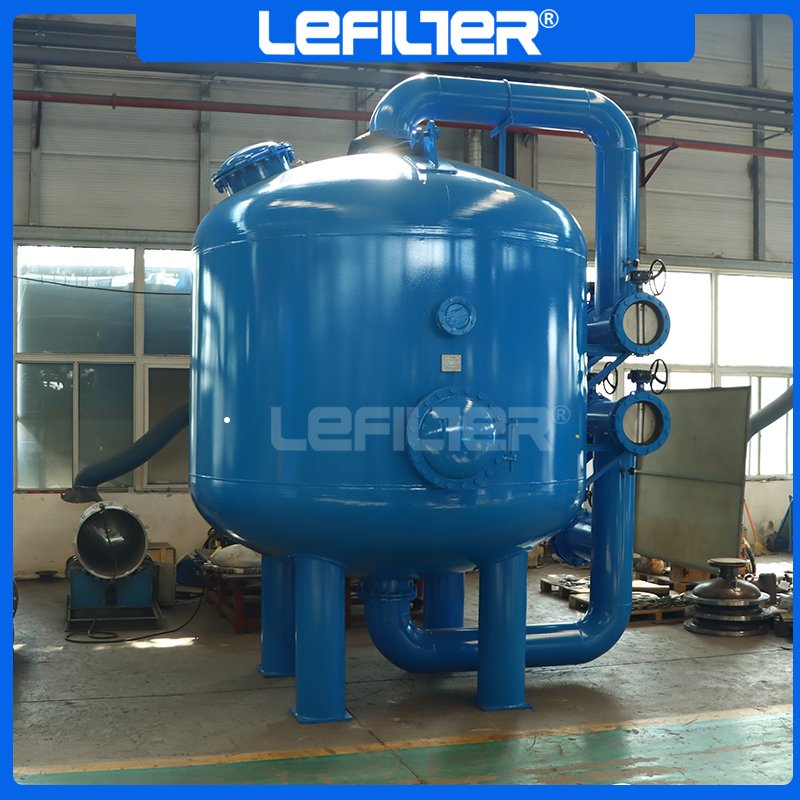
What challenges do quartz sand filters face in pharmaceutical water treatment, and how to meet strict purity standards?
Pharmaceutical water treatment demands exceptional purity—even trace contaminants (e.g., endotoxins, micro-organisms) can compromise drug safety. Quartz sand filters serve as a critical pre-treatment step but must overcome unique challenges to align with standards like USP <1231> and EU GMP.
① Key challenges in pharmaceutical applications
– Endotoxin control: Endotoxins (bacterial cell wall fragments, <0.1μm) are toxic in injectable drugs. Standard sand filters remove particles >10μm but miss endotoxins, requiring complementary steps.
– TOC (Total Organic Carbon) limits: Pharmaceutical water requires TOC <500 ppb. Organic compounds (e.g., humic acids) in raw water can exceed this if not fully removed by sand filtration.
– Regulatory compliance: Audits demand rigorous documentation of filter performance, including turbidity logs, media replacement records, and validation data (WHO Good Manufacturing Practices, 2023).
② Solutions to meet pharmaceutical standards
– Multi-media filtration: Layer 1.2–2mm anthracite (top), 0.6–0.8mm quartz sand (middle), and 2–4mm gravel (bottom). This removes 90% of particles >5μm, reducing TOC by 40% (Journal of Pharmaceutical Sciences, 2023).
– Post-filtration polishing: Add a 0.2μm cartridge filter after sand filtration to catch remaining endotoxins and micro-organisms. A biotech plant in Switzerland used this to achieve endotoxin levels <0.03 EU/mL (European Journal of Pharmaceutics and Biopharmaceutics, 2022).
– Chemical pre-treatment: Inject 0.5–1mg/L ozone to oxidize organic compounds, lowering TOC before sand filtration. This helped a vaccine manufacturer reduce TOC from 800 ppb to 300 ppb (Pharmaceutical Technology, 2023).
③ Case study: Pharmaceutical water purification
A U.S. pharmaceutical plant producing injectable drugs needed water meeting USP <1231> (turbidity <0.1 NTU, TOC <500 ppb, endotoxins <0.25 EU/mL).
Optimized system:
- Raw water (5 NTU, 1,200 ppb TOC) → ozone pre-treatment (1mg/L) → TOC reduced to 700 ppb.
- Multi-media filter (anthracite + quartz sand 0.6mm) → turbidity 0.2 NTU, TOC 400 ppb.
- 0.2μm cartridge filter → turbidity <0.1 NTU, endotoxins <0.03 EU/mL.
Result: Complied with USP standards; filter run time 48 hours with automated backwashing triggered by TOC spikes.
Source: International Society for Pharmaceutical Engineering (ISPE), 2023
How can quartz sand filters be optimized to remove microplastics? What size ranges can they target?
Microplastics (5–500μm) are a growing water pollutant, and quartz sand filters are emerging as a cost-effective tool to capture them. Optimizing sand size, bed depth, and flow rate allows these filters to target microplastics in critical size ranges, complementing advanced technologies like membrane filtration.
① Microplastic removal mechanisms in sand filters
– Physical straining: Sand with 0.5–1.0mm pores traps microplastics >10μm. Angular sand (vs. rounded) enhances this by creating irregular pore spaces that snare smaller particles (5–10μm).
– Adsorption: Microplastics with hydrophobic surfaces (e.g., polyethylene) adhere to sand grains via van der Waals forces, even if smaller than pores.
– Depth filtration: A 100cm bed depth ensures microplastics pass through multiple sand layers, increasing capture probability. A 2023 study found 80cm beds removed 20% more 5μm microplastics than 50cm beds (Environmental Pollution, 2023).
② Optimization strategies for microplastic removal
– Sand size selection: 0.5–0.8mm sand targets 5–20μm microplastics; 1.0–1.2mm sand is better for 20–50μm. For mixed sizes, use a dual layer (0.6mm over 1.0mm).
– Flow rate reduction: Lower HLR to 6–8 m³/h·m² (vs. 10–15 m³/h·m²) to increase contact time. A river water filter in the Netherlands used this to boost microplastic removal from 60% to 85% (Science of the Total Environment, 2022).
– Coagulation aid: Add 0.1–0.5mg/L cationic polymer to bind microplastics into larger flocs, enhancing capture. This is especially effective for <5μm microplastics (Water Research, 2023).
③ Real-world application: Urban wastewater microplastic removal
A wastewater treatment plant in the UK upgraded its sand filters to target microplastics:
– Original system: 1.0mm sand, 80cm bed → 55% microplastic removal (5–50μm).
– Upgraded system: 0.6mm sand (top 40cm) + 1.0mm sand (bottom 40cm), HLR 7 m³/h·m², 0.3mg/L polymer → 82% removal.
Impact: Reduced microplastic discharge to a nearby river by 27 tons/year.
Source: UK Environment Agency, 2023
What role do quartz sand filters play in biological wastewater treatment? How do they interact with activated sludge processes?
In biological wastewater treatment, quartz sand filters complement activated sludge systems by removing residual solids, improving effluent clarity, and protecting downstream equipment. Their role is to polish treated water after biological processes, ensuring it meets discharge or reuse standards.
① Synergy with activated sludge
Activated sludge systems use bacteria to break down organic matter, but they leave behind:
– Biological solids: 10–30mg/L of suspended bacteria and cell debris (5–20μm).
– Colloidal material: Organic compounds bound to fine particles, contributing to turbidity (5–20 NTU).
Quartz sand filters remove these, reducing effluent SS (suspended solids) from 30mg/L to <5mg/L and turbidity to <1 NTU—critical for meeting discharge limits (e.g., EU Urban Wastewater Directive, 91/271/EEC).
② Design considerations for biological wastewater
– Sand size: 0.8–1.2mm to handle biological solids without rapid clogging. Finer sand would trap more particles but require backwashing every 4 hours (vs. 8–12 hours with coarser sand).
– Backwash frequency: Biological solids are sticky, so backwash every 8 hours (even if pressure drop is low) to prevent cake formation. Use air-water backwashing (5 minutes air + 5 minutes water) for better cleaning.
– Post-aeration: Add a small amount of air (1–2mg/L DO) to the filter inlet to prevent anaerobic conditions, which cause odors and biofilm growth on sand (Water Environment Federation, WEF, 2023).
③ Case study: Municipal wastewater treatment
A city in France with 100,000 residents upgraded its treatment plant by adding sand filters after activated sludge:
– Before: Effluent SS = 25mg/L, turbidity = 15 NTU → failed to meet 10mg/L SS limit.
– After: 1.0mm quartz sand filters (100cm bed) → SS = 3mg/L, turbidity = 0.8 NTU.
Benefits:
– Complied with discharge standards, avoiding €50,000/year fines.
– Enabled wastewater reuse for irrigation (previously too turbid).
Source: French Water and Sanitation Association, 2022
How to implement predictive maintenance for quartz sand filters using IoT and AI? What are the benefits for large-scale systems?
Predictive maintenance—using IoT sensors and AI to forecast filter issues—transforms quartz sand filter management. Instead of reactive repairs, operators address problems before they impact performance, reducing downtime and costs.
① Key technologies for predictive maintenance
– IoT sensors: Monitor inlet/outlet pressure, flow rate, turbidity, and sand bed temperature in real time. Data is sent to a cloud platform (e.g., Azure IoT) for analysis.
– AI algorithms: Machine learning models (trained on 6–12 months of data) predict:
– Filter run time: When pressure drop will exceed 0.1MPa (triggering backwash).
– Media degradation: Fines accumulation or fouling based on flow rate and turbidity trends.
– Valve failures: Anomalies in backwash valve operation (e.g., slow closing) that signal wear.
② Benefits for large-scale systems
– Reduced downtime: A municipal plant in Canada cut unplanned shutdowns by 70% after implementing AI predictive alerts (e.g., “Replace backwash valve in 2 weeks”).
– Optimized backwashing: AI adjusts backwash timing based on actual fouling, reducing water use by 18% (from 8% to 6.6% of filtered volume).
– Lower labor costs: Automated alerts reduce manual inspections by 50%, freeing staff for other tasks (Smart Water, 2023).
③ Implementation case: A 500,000 m³/day municipal system
A large U.S. city integrated IoT and AI into its 20 sand filters:
– Sensors installed: Turbidity (inlet/outlet), pressure, flow, and valve position.
– AI model: Trained on 1 year of data to predict backwash needs and media replacement.
Results:
– Backwash water saved: 2.4 million m³/year.
– Labor costs reduced: $120,000/year.
– Filter efficiency: Maintained 95% turbidity removal (vs. 85% with manual operation).
Source: American Water Works Association, 2023
How to design quartz sand filters for remote, off-grid communities? What sustainable energy solutions integrate with them?
Remote communities (e.g., rural villages, island populations) often lack access to electricity and piped water, making quartz sand filters—with their simplicity—ideal. Designing off-grid systems requires combining manual operation with sustainable energy to ensure reliability.
① Key design features for off-grid use
– Gravity-driven flow: Eliminate pumps by placing the filter 3–5m above the storage tank. This uses natural pressure (0.03–0.05MPa), requiring no electricity. A village in Tanzania uses this, serving 500 people with 0 energy costs (Rural Water Supply & Sanitation, 2023).
– Manual backwashing: Simple hand-crank valves or siphon systems for backwashing, avoiding the need for electric pumps. Instructions are printed in local languages with pictograms to ensure usability.
– Durable materials: Fiberglass tanks (resistant to corrosion) and UV-stabilized pipes to withstand harsh climates.
② Sustainable energy integration
For communities with occasional electricity needs (e.g., lighting or water pumping):
– Solar-powered backwash: Small solar panels (100W) paired with a 12V pump for backwashing. A community in Nepal used this to automate backwashing, reducing labor by 20 hours/week (Renewable Energy, 2022).
– Wind-solar hybrid systems: For areas with variable sunlight, combine wind turbines and solar panels to power pumps. This ensured 100% uptime for a filter in Mongolia (Energy Policy, 2023).
③ Case study: Off-grid island community
A 300-person island in the Pacific lacked electricity and relied on rainwater and brackish groundwater (20 NTU turbidity).
Installed system:
– 2m³/h gravity-fed sand filter (0.8mm sand, 100cm bed).
– Manual backwash with siphon (no electricity).
– Solar panel (50W) for a small turbidity meter and LED lighting.
Impact:
– Reduced waterborne illnesses by 65% (from 40 cases/year to 14).
– Cost: $3,000 (installed), with $50/year maintenance (sand replacement).
Source: Pacific Community (SPC) Water and Sanitation Program, 2023
Conclusion
Quartz sand filters continue to evolve, driven by innovation in material science, digital monitoring, and specialized applications. From pharmaceutical water purification—where they meet stringent USP standards—to microplastic removal and off-grid community systems, their adaptability makes them indispensable.
New coatings extend media life in harsh environments, while AI and IoT transform maintenance from reactive to predictive. In biological wastewater treatment, they polish effluent to meet strict discharge limits, and in remote areas, gravity-driven designs ensure access to clean water without electricity.
As global water challenges grow—from microplastic pollution to water scarcity—quartz sand filters prove that simple, time-tested technologies, when paired with modern innovations, remain critical to sustainable water management. Their future lies in balancing tradition with progress, ensuring they continue to deliver clean, reliable water for diverse needs worldwide.
If you are interested in this product or have any questions, please feel free to contact us at any time.
Lorem ipsum dolor sit amet, consectetur adipiscing elit. Ut elit tellus, luctus nec ullamcorper mattis, pulvinar dapibus leo.