UF Membrane Module for Hydranautics Hydracap Max 40 Equivalent Ultrafiltration Membrane
The Hydranautics HYDRAcap MAX 80 is a high-performance ultrafiltration (UF) membrane module designed for industrial and municipal water treatment applications. Below is a detailed overview of its features, specifications, and usage guidelines based on the provided search results:
- Material and Structure:
- Constructed with PVDF (polyvinylidene fluoride) hollow fibers using the TIPS (thermally induced phase separation) method.
- 0.08 μm pore size, optimized for removing particles, colloids, bacteria (≥99.999% removal), and viruses (≥99.99% removal).
- Outside-in flow design with high mechanical strength, reducing fiber breakage and ensuring stable performance.
- Efficiency and Performance:
- Large membrane area: 105 m² (1130 ft²), enabling high water flux and reduced system footprint.
- High tolerance to feed water fluctuations and resistance to fouling due to air scouring technology, eliminating the need for a backwash pump.
- Operates in dead-end or cross-flow modes, suitable for diverse water sources, including high-turbidity (up to 300 NTU) and wastewater.
- Cleaning and Maintenance:
- Utilizes physical air scouring and chemical cleaning (e.g., NaOH, HCl) with a pH tolerance of 1.0–13.0 during cleaning cycles.
- Low maintenance frequency: Maintenance cleaning 1–3 times/day, with gas scouring every 20–60 minutes.
Technical Specifications
| Parameter | Value |
|---|---|
| Membrane Area | 105 m² (1130 ft²) |
| Flow Rate | 3.6–11.6 m³/h (15.7–51.0 gpm) |
| Operating Pressure | ≤5 bar (73 psig) |
| Max Temperature | 40°C (104°F) |
| pH Range (Operation) | 2.0–11.0 (adjustable based on temperature) |
| Chlorine Tolerance | 5000 ppm (instantaneous), 100,000–750,000 ppm-hrs (long-term) |
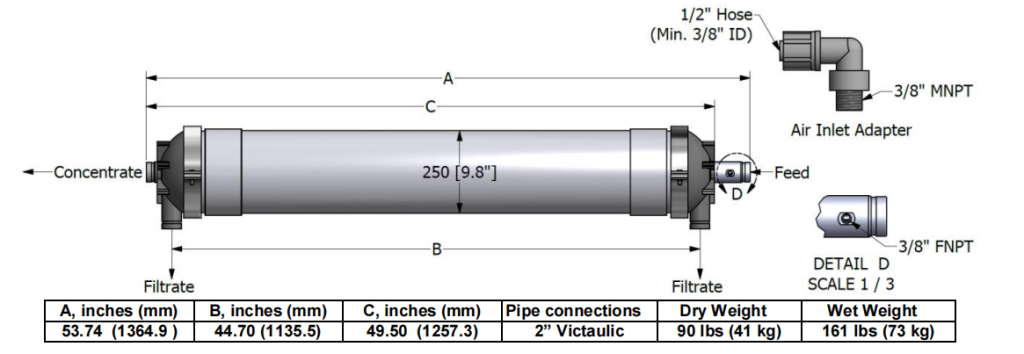
| Dimensions | Length: ~1,860 mm; Diameter: 225 mm |
Applications
- Drinking Water Treatment: Removes pathogens (e.g., Cryptosporidium, Giardia) and ensures compliance with safety standards.
- RO/NF Pretreatment: Protects downstream membranes by reducing turbidity and organic loading.
- Industrial Wastewater: Treats effluents from steel, paper, chemical, and oil industries.
- Municipal Water Reuse: Enables efficient recycling of wastewater.
- Seawater Filtration: Replaces traditional methods like coagulation and sand filtration in desalination systems.