Ultrafiltration Systems
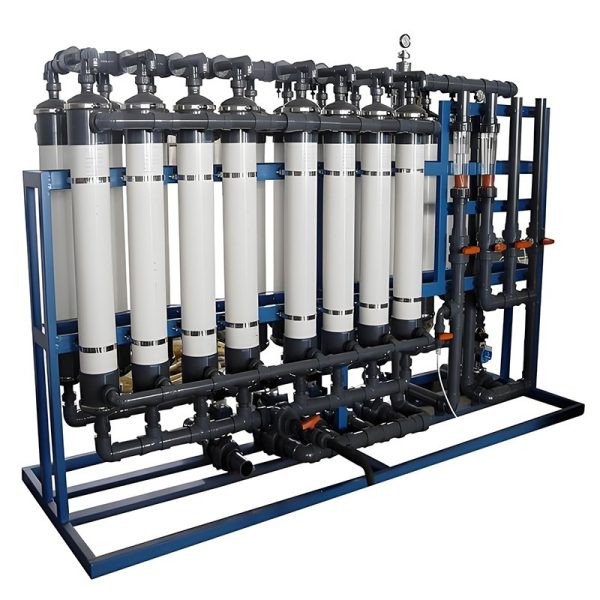
Maximum water temperature
5~40℃
PH tolerance range
1-12
Produced water flux
30-100L/ ㎡ ·h
Backwash flux
90-150L/ ㎡·h
Maximum inlet pressure
0.5MPa
Maximum transmembrane differential pressure
0.2MPa
Maximum backwashing differential pressure
0.2MPa
Filtration cycle
15-60min
Backwashing time
30-180s
Introduction
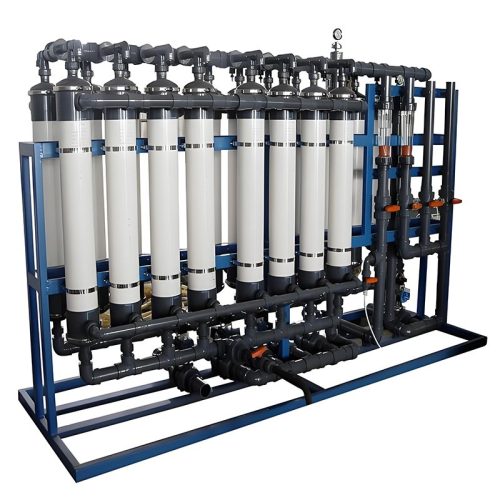
Ultrafiltration (UF) is one of the membrane separation technologies driven by pressure, with the purpose of separating macromolecules from small molecules, i.e., under a certain pressure, to make small molecules of solutes and solvents pass through a certain pore size of the special membrane, while the macromolecules of solutes can not be permeated, to achieve the purpose of purification, separation or concentration of the solution. Generally speaking, the pore size of ultrafiltration membrane between 0.03μm-1μm, the operating pressure of 0.1-0.5Mpa, can effectively remove particles, colloids, bacteria, heat and macromolecular organic substances in water.
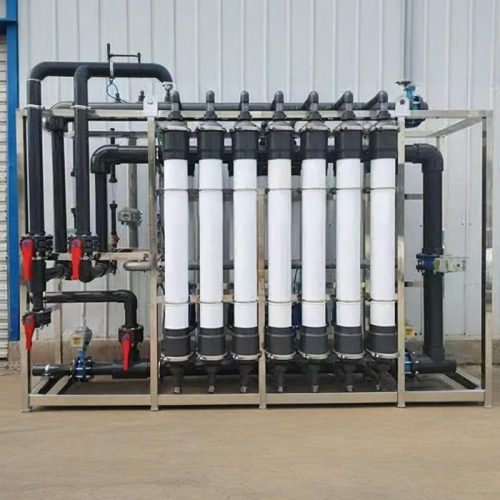
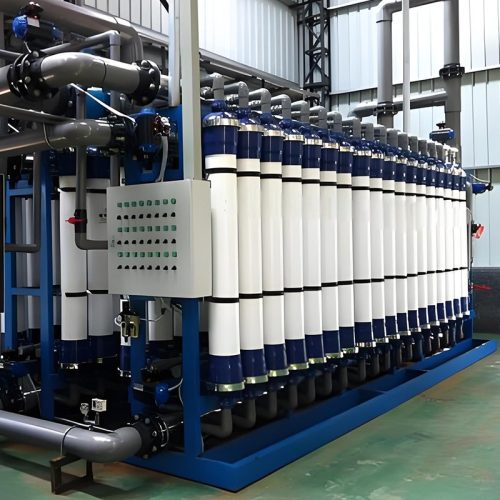
Product Features
▪ The separation process does not cause phase change, and does not cause changes in temperature and pH, thus preventing the denaturation, inactivation and autolysis of biomacromolecules;
▪ The separation process can be carried out at normal temperature and consumes little energy;
▪ The separation process is driven only by low pressure, the equipment and process flow are simple, the cost is low, no chemical reagents are required, and it is easy to operate, manage and maintain;
▪ The application range is wide. Ultrafiltration separation technology can be used for solutes with molecular weights of 1000~500000 Daltons or solute sizes of about 0.03~0.1μm.
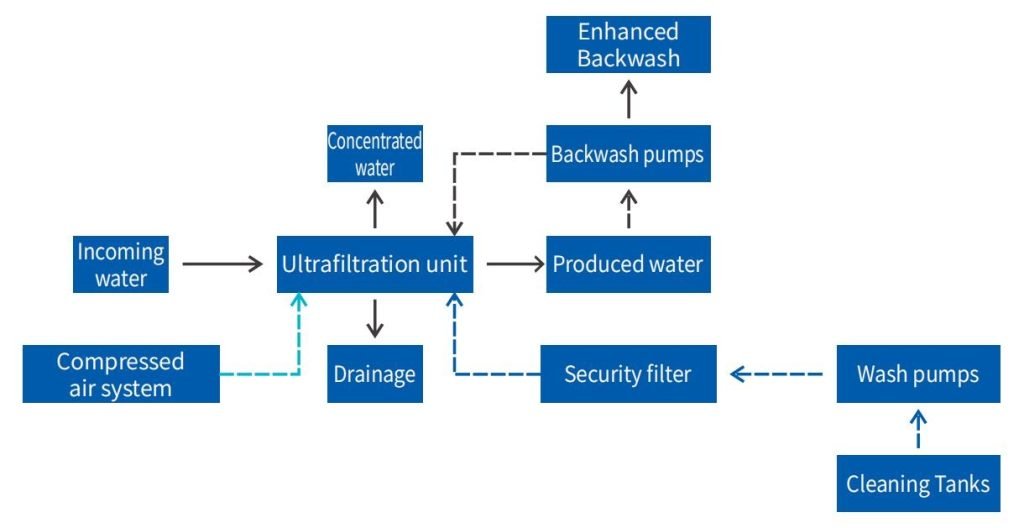
Workflow Diagram
Working Principle
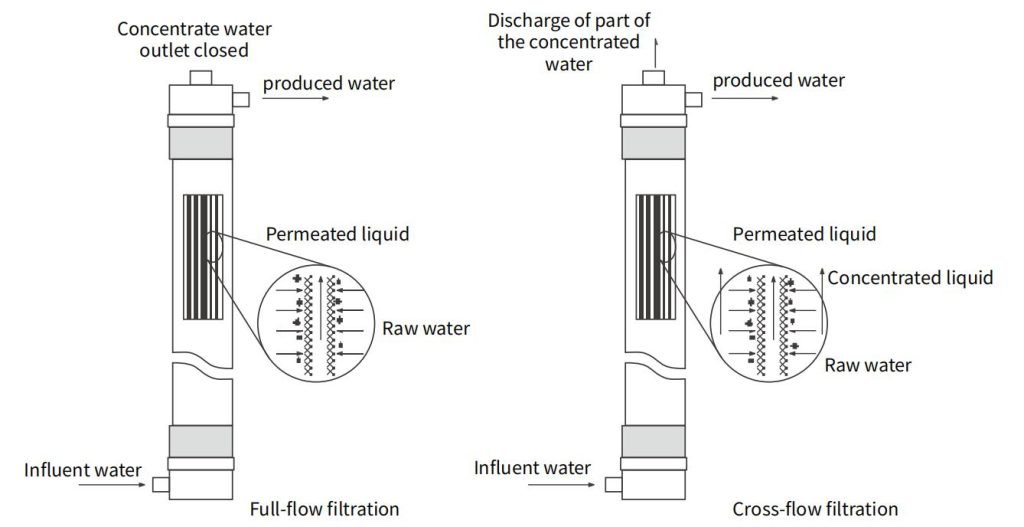
During the ultrafiltration process, the aqueous solution flows through the membrane surface under pressure. The solvent (water) and small molecular solutes smaller than the membrane pores permeate the membrane and become purified liquid (filtrate), while the solutes larger than the membrane pores are retained and discharged with the water flow to become concentrated liquid.
There are two modes of ultrafiltration operation: full-flow filtration (dead-end filtration) and cross-flow filtration. In full-flow filtration, all the influent water passes through the membrane surface to become produced water; while in cross-flow filtration, part of the influent water passes through the membrane surface to become produced water, and the other part is discharged with impurities to become concentrated water. Full-flow filtration has low energy consumption and high recovery rate, so the operating cost is lower; while cross-flow filtration can treat fluids with higher suspended matter content. The specific operation mode should be determined according to the suspended matter content in the water.
Technical Parameter
| Model | Water production | Influent Pressure | water inlet | water outlet | top pipe diameter | downstream piping diameter | Enhanced backwash | air flushing |
| (m³/h) | ||||||||
| LF-UF-001 | 1 | ≤ 0.3MPa | DN20 | DN20 | DN20 | DN20 | Yes | Selectable |
| LF-UF-003 | 3 | ≤ 0.3MPa | DN25 | DN25 | DN32 | DN32 | Yes | Selectable |
| LF-UF-005 | 5 | ≤ 0.3MPa | DN32 | DN32 | DN40 | DN40 | Yes | Selectable |
| LF-UF-010 | 10 | ≤ 0.3MPa | DN50 | DN50 | DN65 | DN65 | Yes | Selectable |
| LF-UF-020 | 20 | ≤ 0.3MPa | DN65 | DN65 | DN80 | DN80 | Yes | Yes |
| LF-UF-030 | 30 | ≤ 0.3MPa | DN80 | DN80 | DN100 | DN100 | Yes | Yes |
| LF-UF-050 | 50 | ≤ 0.3MPa | DN100 | DN100 | DN125 | DN125 | Yes | Yes |
| LF-UF-060 | 60 | ≤ 0.3MPa | DN125 | DN125 | DN150 | DN150 | Yes | Yes |
| LF-UF-080 | 80 | ≤ 0.3MPa | DN125 | DN125 | DN150 | DN150 | Yes | Yes |
| LF-UF-100 | 100 | ≤ 0.3MPa | DN150 | DN150 | DN200 | DN200 | Yes | Yes |
| LF-UF-120 | 120 | ≤ 0.3MPa | DN150 | DN150 | DN200 | DN200 | Yes | Yes |
| LF-UF-150 | 150 | ≤ 0.3MPa | DN150 | DN150 | DN200 | DN200 | Yes | Yes |
| LF-UF-200 | 200 | ≤ 0.3MPa | DN200 | DN200 | DN250 | DN250 | Yes | Yes |
| Note: The design flux of ultrafiltration membrane should be adjusted according to the nature of raw water and various indicators. | ||||||||
Application
1. Drinking water, ultrafiltration only removes suspended solids, colloidal particles, bacteria and other impurities in the water, and retains the minerals that are beneficial to human health.
2. Municipal, family, school, restaurant, hotel, commercial, rural water; pure water before / after treatment.
3. Desalination, pharmaceutical water, chemical industry pure water system, biological engineering system, food and beverage pure water system.
4. Water, sewage, waste water treatment and reuse.
5. Oily wastewater, heavy metal wastewater, textile printing and dyeing wastewater, paper industry wastewater, municipal sewage treatment.
6. Special solution separation and concentration.
7. Concentration and separation of biotechnology, purification of Chinese medicine preparation, concentration and removal of impurities, starch recycling applications, food and beverage concentration and clarification applications.