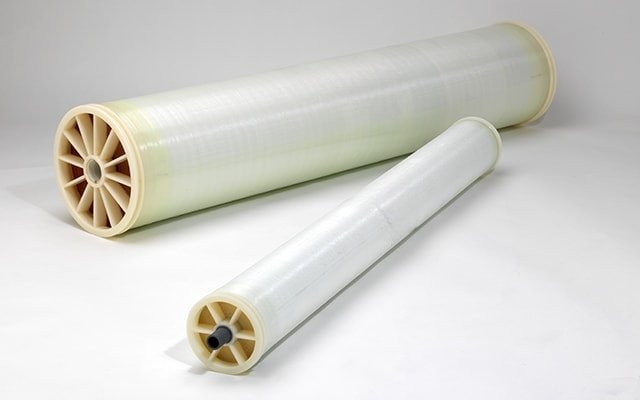
Product Introduction
- RO membrane, namely reverse osmosis membrane, is made of aromatic polyamide composite materials, featuring high desalination and low energy consumption.
- With a pore size of less than 0.0001μm, it can effectively intercept more than 99% of salts, organic matters, bacteria, and viruses in water.
- Suitable for all kinds of reverse osmosis equipment, it is the core component for preparing ultra – pure water.
Working Process
- Pressure Driving: Under a pressure of 1.0 – 1.5MPa, water molecules overcome the osmotic pressure and pass through the RO membrane.
- Selective Filtration: Utilizing the semi – permeability of the membrane, water molecules pass through while salts and macromolecular substances are retained.
- Concentration and Separation: The retained substances are concentrated on the membrane surface to form concentrated water, and the product water enters the collection system.
Product Features
- High Desalination Rate: The removal rate of sodium chloride can reach more than 99.5%.
- Low – pressure Operation: Compared with traditional membrane elements, the operating pressure is reduced by 10 – 15%.
- Anti – fouling Property: The smooth surface structure reduces the adhesion of pollutants and extends the service life.
- Standardized Size: Compatible with mainstream reverse osmosis equipment in the market, facilitating installation and replacement.
Technical Parameters
| Item | Parameter Range |
|---|---|
| Membrane Material | Aromatic polyamide composite materials |
| Effective Membrane Area | 16 – 40㎡ |
| Desalination Rate | ≥99% |
| Applicable Temperature | 5 – 45℃ |
| Maximum Operating Pressure | 4.14MPa |
Application Areas
- Electronics Industry: Preparation of water for chip manufacturing and semiconductor cleaning.
- Pharmaceutical Industry: Production of water for injection and pharmaceutical purified water.
- Seawater Desalination: Drinking water supply for islands and ships.
- Chemical Industry: Concentration of chemical raw materials and wastewater treatment and reuse.
FAQ
Question 1: How to determine if the RO membrane needs to be cleaned?
Answer: When the water production of the equipment decreases by 15%, the desalination rate decreases by 10%, or the operating pressure increases by 15%, the RO membrane needs to be chemically cleaned. Acid, alkali, or special cleaning agents can be selected according to the type of pollutants.
Question 2: What is the service life of the RO membrane?
Answer: Under normal working conditions, the service life is 2 – 3 years. If the raw water quality is poor, the pretreatment is insufficient, or the operation is improper, the service life will be shortened. It is recommended to regularly monitor the membrane performance and perform maintenance.
Answer: When the water production of the equipment decreases by 15%, the desalination rate decreases by 10%, or the operating pressure increases by 15%, the RO membrane needs to be chemically cleaned. Acid, alkali, or special cleaning agents can be selected according to the type of pollutants.
Question 2: What is the service life of the RO membrane?
Answer: Under normal working conditions, the service life is 2 – 3 years. If the raw water quality is poor, the pretreatment is insufficient, or the operation is improper, the service life will be shortened. It is recommended to regularly monitor the membrane performance and perform maintenance.
Conclusion
With excellent desalination performance and stable filtration effect, the high – performance RO membrane has become a key core component for deep water treatment in various industries, providing reliable technical support for ensuring high – quality water use.