Product Introduction
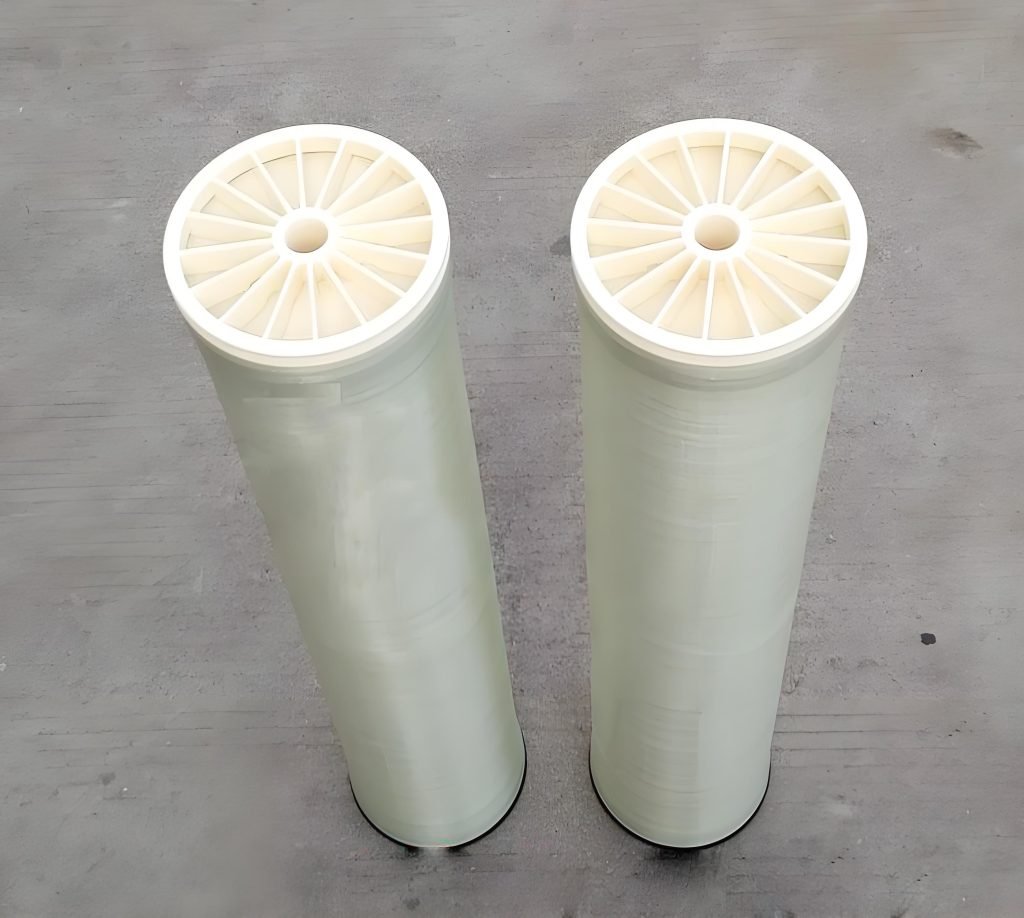
As a flagship product from DuPont (formerly Dow FilmTec), the BW30-400 reverse osmosis (RO) membrane establishes industry standards for brackish water treatment through its aromatic polyamide thin-film composite (TFC) technology. This 8-inch diameter × 40-inch length spiral-wound element, with 37.2 m² of effective filtration area, delivers 37.8 m³/day of permeate while maintaining salt rejection >99.5%. Its technological breakthrough lies in integrating nanoscale filtration precision with hydrodynamic design, addressing flux decline in high-salinity environments and extending chemical cleaning cycles by 1.5× through anti-fouling surface modification—making it the preferred solution for municipal water supply, industrial recirculation, and seawater desalination pre-treatment.
Nanoscale Filtration Mechanisms and Structural Innovations
- Selective Permeation Principles of Composite Membranes
The BW30-400’s filtration core features a three-layer gradient structure:
- Active Separation Layer: An interfacial polymerized polyamide network with pore sizes controlled at 0.0001 microns utilizes charge repulsion (membrane surface zeta potential -35mV) for efficient ion rejection, achieving >99.8% rejection of divalent Ca²⁺/Mg²⁺ ions.
- Support Transition Layer: A microporous polysulfone matrix balances structural integrity (150MPa tensile modulus) and permeability with 200nm porosity, withstanding operational pressures up to 4.1MPa.
- Flow Distribution Layer: A food-grade polypropylene spacer with 28mil thickness forms turbulent channels. CFD-optimized corrugation angles (30°±5°) maintain a concentration polarization coefficient <1.2, preventing solute accumulation.
- Anti-Fouling Surface Engineering
Grafted polyethylene glycol (PEG) chains on the membrane surface create a hydrophilic hydration layer, reducing contact angle from 65° to 42° and decreasing organic adsorption by 40%. In a textile wastewater reuse project, this modification maintained a stable flux of 10.2L/m²·h at COD 800mg/L—25% higher than unmodified membranes.
Operational Excellence in Industrial Applications
- Municipal Water Deep Purification
In an Abu Dhabi groundwater treatment project, BW30-400 modules processed water with 2,800ppm TDS at 180psi (1.24MPa), reducing TDS to 47ppm—exceeding WHO standards. Online fluoride monitoring showed 97.3% rejection, lowering fluoride from 1.8ppm to <0.05ppm and addressing long-term regional fluorosis issues. - Zero-Discharge Practices in Industrial Recirculation
A 300MW coal-fired power plant adopted BW30-400 for boiler feed water treatment via a two-stage RO design:
- Stage 1 achieved 75% recovery from circulating blowdown water (3,500ppm TDS), yielding water with conductivity <5μS/cm.
- Stage 2 further reduced silica from 8ppm to <0.1ppm, preventing boiler scaling.
This solution reduced acid/alkali usage by 80% compared to traditional ion exchange, saving ¥1.2M/year in chemical costs and decreasing wastewater discharge from 200t/h to 40t/h.
- Pre-Treatment Revolution in Seawater Desalination
In Jeddah’s SWRO project, BW30-400 pre-treatment reduced the silt density index (SDI) from 5.2 to 2.1, extending seawater membrane cleaning cycles from 21 to 60 days when combined with ultrafiltration. This optimization lowered desalination energy consumption from 4.8kWh/ton to 3.9kWh/ton, saving ~$3M/year for a 100,000m³/day plant.
Full Lifecycle Performance Management
- Intelligent Operation & Maintenance System
Integrated MEMS pressure sensors monitor differential pressure with 0.1psi precision, triggering a three-stage cleaning protocol when pressure drop increases by 15%:
- Low-flow flushing (1.5× normal velocity) removes loose sediments.
- 4% citric acid (pH3.5) circulates to clean organic fouling.
- 0.5% sodium hypochlorite (pH10) inactivates biofilms.
A pharmaceutical plant extended membrane life from 3 to 5 years using this system, maintaining 99.7% product water qualification rate.
- Environmentally Friendly Design
The membrane uses chromium-free glass fiber-reinforced polyester housing (UL94 V-0 flame rating), recyclable via supercritical water oxidation with 92% material recovery. In a California semiconductor plant retrofit, recycled membranes were converted into carbon fiber-reinforced plastics for equipment frameworks, closing the waste loop.
Technological Frontiers and Industry Trends
- Nanocomposite Membranes: Graphene oxide (GO)-polyamide hybrid modification increases water flux by 18% while maintaining salt rejection rates above 99.5%. This breakthrough stems from GO’s atomic-scale hydrophilic channels, which enhance water transport without compromising the polyamide matrix’s selectivity. Pilot tests in a Texas oilfield water treatment plant demonstrated that GO-modified BW30-400 elements achieved 12.1 L/m²·h flux at 5,000ppm TDS, outperforming conventional membranes by 22% under identical pressure conditions. The nanocomposite structure also exhibits enhanced chlorine tolerance, withstanding 0.5ppm free chlorine for 4 hours without significant performance degradation—a critical advantage for emergency water treatment scenarios.
- AI-Enabled Predictive Maintenance: Machine learning algorithms integrated with BW30-400 systems analyze multi-parameter datasets (flow rate, pressure drop, permeate conductivity, and feed water quality) to predict fouling onset with 92% accuracy. In a Chilean copper mine’s water recycling plant, this technology reduced unplanned shutdowns by 85%, saving $450,000 annually in maintenance costs. The AI model employs long short-term memory (LSTM) networks to recognize subtle patterns in real-time data—such as a 0.05MPa/week increase in differential pressure combined with a 3% decline in salt rejection—triggering proactive cleaning protocols before performance thresholds are breached.
Environmental and Economic Implications
- Energy Efficiency: The 18% flux increase translates to 15–20% lower pumping energy, with a municipal water plant in India achieving 0.7kWh/m³ energy consumption—25% below the regional average.
- Waste Reduction: AI-optimized cleaning reduces chemical usage by 35%, while nanocomposite membranes extend service life to 6–8 years, decreasing membrane waste by 30%. In a California water reclamation facility, this resulted in 120 tons of membrane waste reduction over a five-year period.
Conclusion
As water stress intensifies, the BW30-400’s technological evolution positions it as a linchpin in circular water systems. The integration of nanomaterials, smart sensors, and predictive analytics not only enhances operational efficiency but also enables new applications—such as direct potable reuse and zero-liquid discharge in heavy industries—ushering in a new era of sustainable water management.
If you are interested in this product or have any questions, please feel free to contact us at any time.