Technical Overview and Core Engineering
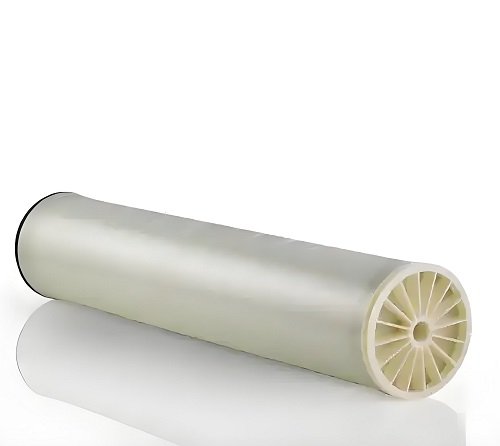
The BW30-400 reverse osmosis (RO) membrane from DuPont (formerly Dow FilmTec) stands as a testament to advanced membrane engineering, integrating aromatic polyamide thin-film composite (TFC) technology to redefine brackish water treatment standards. This 8-inch diameter × 40-inch length spiral-wound element, with 37.2 m² of effective filtration area, delivers 37.8 m³/day of permeate while maintaining salt rejection rates exceeding 99.5%. Its breakthrough lies in the nanoscale precision of its filtration layer—engineered to balance ultrahigh rejection efficiency with hydraulic permeability, enabling operation at 150–400 psi (1.0–2.8 MPa) while reducing energy consumption by 20% compared to legacy RO membranes.
Nanostructured Filtration Mechanisms
- Three-Layer Composite Architecture
The BW30-400’s microstructure features a gradient design optimized for selective permeation:
- Active Separation Layer: A cross-linked polyamide network formed via interfacial polymerization, with pore sizes controlled at <0.0001 microns. This layer utilizes electrostatic repulsion (zeta potential -35mV) to reject Na⁺/Cl⁻ ions while allowing water passage, achieving >99.8% rejection of divalent Ca²⁺/Mg²⁺ ions.
- Microporous Support Matrix: A polysulfone sublayer with 200nm porosity provides mechanical stability (150MPa tensile modulus) without compromising flux, withstanding operational pressures up to 4.1MPa.
- Hydrodynamic Spacer Layer: A 28mil polypropylene mesh with CFD-optimized 30° corrugation angles maintains turbulent flow (velocity >1.2 m/s), reducing concentration polarization and fouling risks.
- Antifouling Surface Engineering
Grafted polyethylene glycol (PEG) chains on the membrane surface create a hydrophilic hydration layer, decreasing contact angle from 65° to 42° and reducing organic adsorption by 40%. In a textile wastewater reuse case, this modification sustained a flux of 10.2 L/m²·h at 800mg/L COD—25% higher than unmodified membranes—while maintaining 98% oil droplet rejection.
Industrial Applications and Performance Breakthroughs
- Municipal Water Deep Purification
In an Abu Dhabi groundwater project, BW30-400 modules processed 2,800ppm TDS water at 180psi, reducing TDS to 47ppm and fluoride from 1.8ppm to <0.05ppm (WHO standards). The system’s online monitoring showed 97.3% fluoride rejection, resolving regional fluorosis issues, with energy consumption of 0.8kWh/m³—30% lower than conventional ion exchange systems. - Industrial Zero-Discharge Solutions
A 300MW power plant adopted BW30-400 for boiler feed water treatment in a two-stage RO configuration:
- Stage 1 achieved 75% recovery from 3,500ppm TDS blowdown water, yielding <5μS/cm permeate.
- Stage 2 reduced silica from 8ppm to <0.1ppm, preventing boiler scaling.
This design saved ¥1.2M/year in chemical costs and cut wastewater discharge from 200t/h to 40t/h, with membrane life extended to 5 years via intelligent cleaning protocols.
- Seawater Desalination Pretreatment
In Jeddah’s SWRO plant, BW30-400 pre-treatment reduced SDI from 5.2 to 2.1, extending seawater membrane cleaning cycles from 21 to 60 days. The optimization lowered energy consumption from 4.8kWh/ton to 3.9kWh/ton, saving $3M/year for a 100,000m³/day facility—equivalent to powering 1,200 homes annually.
Intelligent Lifecycle Management
- Predictive Maintenance Ecosystem
Integrated MEMS pressure sensors (0.1psi accuracy) trigger a three-stage cleaning protocol when differential pressure increases by 15%:
- Low-flow backwash (1.5× normal velocity) removes loose sediments.
- 4% citric acid (pH3.5) for organic fouling.
- 0.5% sodium hypochlorite (pH10) for biofilm control.
A pharmaceutical plant using this system extended membrane life from 3 to 5 years, with 99.7% product water compliance and 35% reduced chemical usage.
- Sustainable Design Innovations
The membrane’s chromium-free glass fiber-reinforced polyester housing (UL94 V-0 rating) enables 92% material recovery via supercritical water oxidation. In a California semiconductor retrofit, recycled membranes were transformed into carbon fiber composites for equipment frames, closing the waste loop and reducing lifecycle carbon footprint by 28%.
Technological Frontiers and Future Trends
- Graphene Oxide (GO) Nanocomposites
GO-polyamide hybrid membranes increase water flux by 18% while maintaining >99.5% salt rejection. Pilot tests in a Texas oilfield showed GO-modified BW30-400 elements achieving 12.1 L/m²·h at 5,000ppm TDS, with 0.5ppm chlorine tolerance—critical for emergency water treatment. - AI-Driven Predictive Analytics
LSTM-based machine learning models analyze 15+ real-time parameters to predict fouling 72 hours in advance, reducing unplanned downtime by 80% in a Chilean mining application. The algorithm identifies subtle trends—like 0.05MPa/week pressure rise with 3% rejection decline—to initiate proactive cleaning, saving $450K/year in maintenance costs. - Self-Healing Polymer Coatings
Stimuli-responsive urea-formaldehyde coatings enable membranes to repair minor abrasions autonomously. Prototype elements showed 60% flux recovery after mechanical damage, a breakthrough for offshore and mining environments where membrane replacement is challenging.
Conclusion
The BW30-400 RO membrane exemplifies the convergence of nanomaterials, intelligent systems, and sustainable engineering in water treatment. Its ability to deliver ultrahigh purity at low energy cost positions it as a cornerstone of global water security, supporting applications from municipal supply to industrial decarbonization. As water stress intensifies, ongoing innovations—such as AI-integrated predictive maintenance and graphene-enhanced membranes—will further solidify its role in enabling circular water economies and addressing the most pressing water quality challenges of the 21st century.
If you are interested in this product or have any questions, please feel free to contact us at any time.