Introduction
Water is the source of life. With the continuous improvement of people’s requirements for water quality, activated carbon water filters have been widely used in many fields such as households, industries and commerce. It can effectively remove pollutants such as organic matter, residual chlorine, odor and some heavy metals in water, and provide better quality drinking water and industrial water. The correct selection is crucial to ensure the performance and economy of the filter.
Types and characteristics of activated carbon
(I) Powdered activated carbon
Adsorption performance: Powdered activated carbon has a large specific surface area, usually up to 1000-1500m²/g, which enables it to provide a large number of adsorption sites and has a strong adsorption capacity for small molecular organic matter, pigments and odor substances in water. For example, when treating water containing trace pesticide residues, powdered activated carbon can effectively adsorb these organic pollutants.
Physical form and usage: It is a very fine powder with a particle size of about tens of microns. In practical applications, powdered activated carbon is usually directly put into water, evenly dispersed by stirring to form a suspension for adsorption. However, the disadvantage of this method is that subsequent filtration and separation are difficult, and sophisticated filtration equipment is required to completely remove the activated carbon particles.
(II) Granular activated carbon
Adsorption performance: The specific surface area of granular activated carbon is generally around 800-1200m²/g. Its adsorption rate is slightly slower than that of powdered activated carbon, because it takes a certain amount of time for the adsorption sites inside it to be contacted by pollutants in the water. However, it has a better adsorption effect on macromolecular organic matter, such as humic acid in water. Moreover, granular activated carbon is not easy to powderize during use and has good stability.
Physical form and usage: The particle size of granular activated carbon is generally between 0.5-4mm. This granular form makes it easy to load into the filter bed of the filter. Water can pass through the filter bed and undergo adsorption reaction in the pores of the granular activated carbon. After adsorption saturation, the granular activated carbon can be easily removed from the filter for replacement or regeneration.
(III) Fiber activated carbon
Adsorption performance: Fiber activated carbon has an ultra-high specific surface area, which can be as high as 1500-3000m²/g. It has a fast adsorption speed because its fibrous structure makes the adsorption site more accessible to pollutants in the water. It has a good adsorption effect on volatile organic compounds (VOCs) and can quickly reduce the odor in the water.
Physical form and usage: It is a fibrous material with an appearance similar to cotton. In the filter, it can be made into a fiber felt or fiber bundle. When water passes through the fiber activated carbon, it can be adsorbed on the surface and internal pores of its fibers, and its resistance is relatively small, which is more suitable for some filtration systems with high flow requirements.

Structural type of filter
(I) Pressure filter
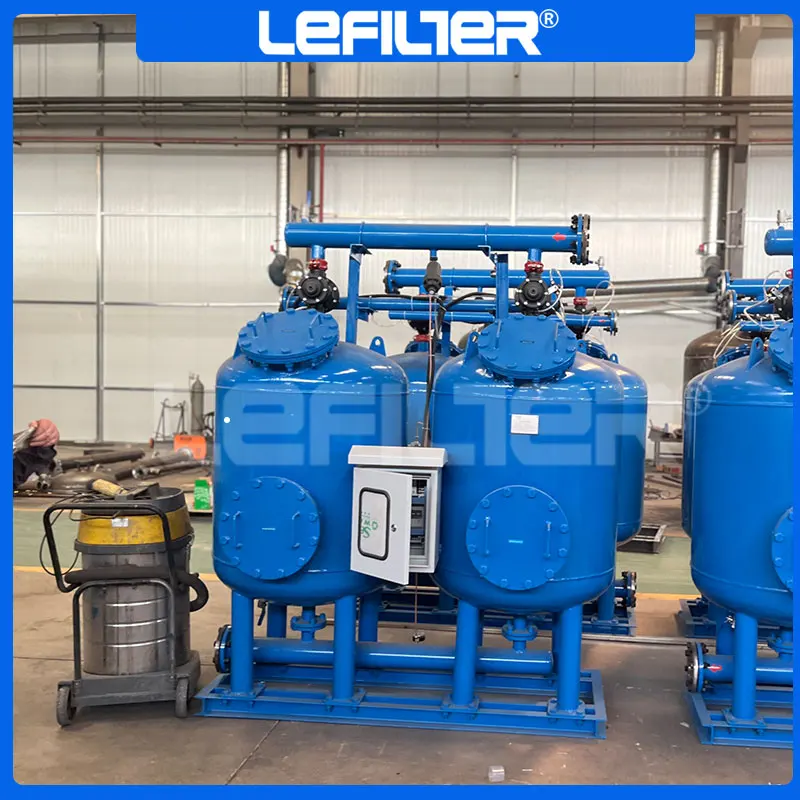
Working principle: The pressure activated carbon water filter operates under a certain pressure. Water is transported to the inside of the filter by a water pump, and under the action of pressure, the water penetrates the activated carbon filter layer. The existence of pressure allows water to pass through the filter at a faster flow rate, which is suitable for occasions with high flow requirements, such as large-scale industrial water treatment or pretreatment of municipal water supply.
Applicable scenarios and advantages and disadvantages: This filter has a compact structure and can withstand high working pressure, generally up to 0.3 – 0.6MPa. Its advantages are high filtration efficiency and the ability to process a large amount of water in a short time. However, its disadvantages are that the equipment cost is relatively high, and because it operates under pressure, the sealing performance of the equipment is required to be high. If there is a sealing problem, it may cause leakage and other faults.
(II) Gravity filter
Working principle: Gravity filter mainly relies on the gravity of water to make water pass through the activated carbon filter layer. Water enters from the top of the filter, and under the action of gravity, it slowly passes through the filter layer and finally flows out from the bottom. The operation of this filter is relatively simple and does not require an additional water pump to provide pressure.
Applicable scenarios and advantages and disadvantages: It is suitable for small water treatment systems, such as water filtration in home aquariums or some small drinking water treatment equipment. Its advantages are simple structure, low cost and easy operation. The disadvantage is that the filtration speed is relatively slow, because it relies entirely on gravity, the amount of water processed per unit time is limited, and the floor space is relatively large.
Flow and treatment capacity
(I) Flow calculation
When selecting a model, the required water flow must be determined first. For household water use, it can generally be estimated based on the number of family members and daily water use habits. For example, an ordinary family of three needs about 300-500 liters of water per day for daily life (including drinking, cooking, washing, etc.). If it is industrial water, it needs to be determined based on the water consumption of the production process and equipment. The calculation formula for flow (Q) is Q = V/t, where V is the amount of water to be treated and t is the treatment time.
Considering the peak water consumption, a certain margin is usually reserved when selecting a model. For example, in household water use, there may be a situation where multiple water-using devices (such as washing machines, shower heads, etc.) are used at the same time, and the flow rate will peak at this time. It is generally recommended to reserve 30%-50% of the margin to deal with this situation.
(II) Treatment capacity and service life
The treatment capacity of activated carbon water filters mainly depends on the adsorption capacity of activated carbon and the design of the filter. The adsorption capacity of activated carbon is related to factors such as the type and quality of activated carbon. For example, the adsorption capacity of high-quality granular activated carbon for organic matter in water may reach 100-300mg/g. When the pollutants adsorbed by activated carbon reach about 80% of its adsorption capacity, it is necessary to consider replacing the activated carbon to ensure the filtering effect.
The service life of the filter is not only related to the adsorption saturation of activated carbon, but also to factors such as water quality and frequency of use. In the case of poor water quality and high content of pollutants in the water, the service life of the filter will be shortened accordingly. For example, when treating industrial wastewater containing high concentrations of organic matter, activated carbon may reach adsorption saturation within a few months, while when treating relatively clean drinking water, the service life of the filter may be extended to 1-2 years.
Influent water quality and effluent requirements
(I) Influent water quality analysis
Before selecting the model, a detailed analysis of the influent water quality is required. It mainly includes testing the organic matter content in the water (such as chemical oxygen demand COD, biochemical oxygen demand BOD, etc.), residual chlorine content, heavy metal content, pH value, etc. For example, if the COD content of the incoming water is high, it means that the water is seriously polluted by organic matter, and it is necessary to select activated carbon with large adsorption capacity and efficient filter structure to ensure the treatment effect.
At the same time, it is also necessary to consider whether the water contains impurities such as suspended matter. If there are more suspended matter in the water, it is necessary to set a pre-filtration device before the activated carbon filter, such as a sand filter or filter screen, to prevent the activated carbon filter layer from being blocked and affecting the filtration efficiency.
(II) Determination of effluent requirements
Determine the water quality requirements of the effluent according to different uses. For drinking water, it is necessary to meet the relevant national drinking water hygiene standards, such as the residual chlorine content in the water should be lower than the specified value, the organic content is extremely low, and it does not contain harmful heavy metals. In terms of industrial water use, different production processes have different requirements for water quality. For example, the electronics industry has extremely high requirements for the content of particles and organic matter in water, and it needs to undergo high-precision activated carbon filtration and other deep treatments to meet production requirements.
Filter material and manufacturing process
(I) Shell material
The shell materials of activated carbon water filters are commonly stainless steel, fiberglass and plastic. Stainless steel shells (such as 304 stainless steel or 316 stainless steel) have good corrosion resistance and high strength, and are suitable for various water quality environments, especially in the industrial field or occasions with strict requirements on water quality. FRP shells are light, corrosion-resistant, and have certain thermal insulation properties. They are more suitable for some occasions with requirements on weight and thermal insulation. Plastic shells (such as ABS plastic, PP plastic, etc.) are low-cost and are often used in small household filters.
When selecting the shell material, factors such as the pH, temperature and use environment of the water quality need to be considered. For example, when treating highly acidic industrial wastewater, it is necessary to select a shell material with good acid resistance, such as FRP or a specific plastic material.
(II) Internal components and manufacturing process
The internal components of the filter include the support layer of activated carbon, the water distribution device and the water collection device. The support layer needs to have sufficient strength to bear the weight of the activated carbon, and at the same time ensure that the water can pass through the activated carbon filter layer evenly. The function of the water distribution device is to evenly distribute the incoming water on the upper part of the activated carbon filter layer to avoid the situation where the local water flow is too large or too small. The water collection device collects filtered water to ensure uniform water quality.
In terms of manufacturing process, high-quality filters usually use precision welding (for stainless steel shells) or injection molding (for plastic shells) processes. Good welding technology can ensure the sealing of the filter, while injection molding technology can make the plastic shell have better integrity and sealing.

Maintenance and operation costs
(I) Maintenance requirements
Activated carbon water filters need to be maintained regularly. It mainly includes checking the adsorption of activated carbon and replacing activated carbon in time when the adsorption is saturated. For granular activated carbon, the replacement process is relatively simple. Just remove the old activated carbon from the filter and then load the new activated carbon. At the same time, it is also necessary to regularly check the internal components of the filter, such as whether the support layer is damaged, whether the water distribution device and water collection device are blocked, etc.
In addition, the filter needs to be cleaned to remove impurities and dirt that may accumulate inside the filter. When cleaning, be careful to avoid damaging the activated carbon and internal components. Mild cleaning agents and appropriate cleaning methods can be used.
(II) Operating costs
Operating costs mainly include the replacement cost of activated carbon, energy consumption (for the operation of the water pump of the pressure filter) and equipment maintenance costs. The replacement cost of activated carbon depends on the type and amount of activated carbon. For example, powdered activated carbon is relatively cheap, but due to its subsequent separation difficulties, other costs may be increased; granular activated carbon is moderately priced and easy to replace, and is a more common choice.
In terms of energy consumption, if it is a pressure filter, the power and running time of the water pump need to be considered. Generally speaking, the greater the power of the water pump, the higher the energy consumption, but it can provide a higher flow rate. Equipment maintenance costs include regular inspections, repairs and replacement of internal components, which are related to factors such as the quality of the filter and the use environment.
Selection steps
(I) Clear demand
First, determine the purpose of water treatment, whether it is for household drinking water, industrial production water or other special purposes. At the same time, it is necessary to clarify the inlet water quality and outlet water quality requirements, including the removal requirements for pollutants such as organic matter, residual chlorine, and heavy metals in the water.
(II) Calculate flow and processing capacity
Calculate the required water flow according to the number of water users or production process, and reserve a margin considering the peak flow. According to the inlet water quality and outlet water requirements, combined with the adsorption capacity of activated carbon, estimate the filter’s processing capacity and the required amount of activated carbon.
(III) Select activated carbon type and filter structure
Select the appropriate activated carbon type, such as powder, granular or fiber activated carbon, according to the inlet water quality and treatment requirements. At the same time, select the pressure or gravity filter structure in combination with the flow rate, processing capacity and usage scenario.
(IV) Consider materials and manufacturing processes
Select the shell material of the filter and the manufacturing process of the internal components according to factors such as water quality, use environment and cost to ensure the quality and service life of the filter.
(V) Evaluate maintenance and operating costs
Evaluate the maintenance requirements and operating costs of the selected filter, including the cost of activated carbon replacement, energy consumption and equipment maintenance costs, to ensure that it is economically reasonable and feasible.
Conclusion
The selection of activated carbon water filter is a process that comprehensively considers multiple factors. It is necessary to weigh multiple aspects such as the type of activated carbon, the structure of the filter, the flow processing capacity, the inlet and outlet water quality, the material manufacturing process and the maintenance and operation cost. Only by selecting the right filter can pollutants in the water be effectively removed to meet different water needs while ensuring the economy and service life of the filter. During the actual selection process, you can also consult professional water treatment equipment suppliers or engineers to obtain more accurate selection suggestions.