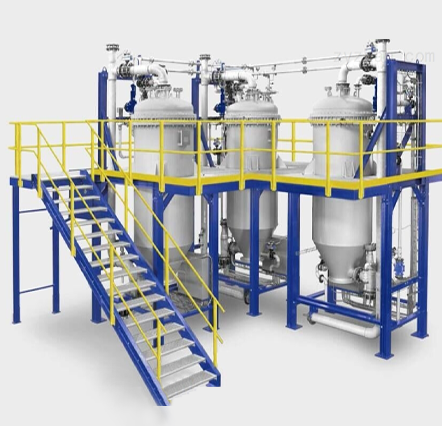
Product Introduction
- Uses candle – shaped filter elements as the core filtration components, achieving solid – liquid separation through the interception of the filter cake layer.
- Suitable for filtering liquids with high viscosity and high solid content, with a filtration accuracy of 0.1 – 50μm.
- The equipment has a compact structure, high degree of automation, and is easy to operate.
Working Process
- Feeding: The liquid to be filtered is transported into the filter by a feed pump.
- Filtration: The liquid passes through the filter medium on the surface of the filter element, and solid particles are intercepted to form a filter cake layer.
- Filter Cake Thickening: As the filtration progresses, the filter cake layer gradually thickens, and the filtration resistance increases.
- Back – Blowing and Slag Discharge: When the set pressure difference or filtration time is reached, compressed air back – blows the filter element, and the filter cake falls off and is discharged from the slag discharge port.
Product Features
- High – precision Filtration: Can meet the high – precision filtration requirements of different working conditions.
- Continuous Operation: Has the functions of online filtration and slag discharge without affecting production continuity.
- Corrosion Resistance: Filter elements and tanks are made of corrosion – resistant materials such as stainless steel and Hastelloy.
Technical Parameters
| Item | Parameter Range |
|---|---|
| Filtration Area | 5 – 100㎡ |
| Working Pressure | ≤1.0MPa |
| Filtration Precision | 0.1 – 50μm |
| Applicable Temperature | -20 – 150℃ |
Application Areas
- Chemical Industry: Catalyst filtration and recovery, resin separation.
- Food and Beverage: Edible oil dewaxing, wine clarification.
- Pharmaceutical Industry: Fermentation broth separation, traditional Chinese medicine extract filtration.
- Environmental Protection Field: Industrial wastewater treatment, sludge dewatering pretreatment.
FAQ
Question 1: How to select the appropriate filter element for the candle filter?
Answer: It is necessary to select the filter element material, pore size, and quantity according to the properties of the liquid to be filtered (such as viscosity, solid content, corrosiveness), filtration accuracy requirements, and production scale. If necessary, small – sample tests can be carried out for determination.
Question 2: What is the appropriate back – blowing pressure for the candle filter?
Answer: The back – blowing pressure is generally controlled at 0.4 – 0.8MPa. Specifically, it needs to be adjusted according to the adhesion of the filter cake and the pressure resistance of the filter element to ensure that the filter cake falls off effectively without damaging the filter element.
Answer: It is necessary to select the filter element material, pore size, and quantity according to the properties of the liquid to be filtered (such as viscosity, solid content, corrosiveness), filtration accuracy requirements, and production scale. If necessary, small – sample tests can be carried out for determination.
Question 2: What is the appropriate back – blowing pressure for the candle filter?
Answer: The back – blowing pressure is generally controlled at 0.4 – 0.8MPa. Specifically, it needs to be adjusted according to the adhesion of the filter cake and the pressure resistance of the filter element to ensure that the filter cake falls off effectively without damaging the filter element.
Conclusion
The efficient candle filter plays an important role in multiple industries with its deep – filtration advantages and stable solid – liquid separation performance, providing reliable equipment support for enterprises to achieve efficient filtration and cost reduction.