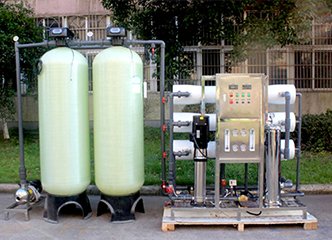
Product Introduction
- Relying on the principle of reverse osmosis of semi – permeable membranes, it can effectively intercept impurities such as inorganic salts, organic matters, bacteria, and viruses in water, achieving deep purification of water quality.
- The desalination rate of the equipment is as high as over 98%, and it can produce ultra – pure water that meets the strict industry standards of electronics, pharmaceuticals, chemicals, etc.
- With a modular design, it can be flexibly combined according to different water production requirements, adapting to various production scales.
Working Process
- Raw Water Pretreatment: The raw water passes through pretreatment equipment such as multi – media filters, activated carbon filters, and precision filters in sequence to remove large – particle impurities, residual chlorine, and some organic matters, reduce the turbidity of the raw water, and provide good inlet water conditions for the reverse osmosis membrane.
- High – pressure Pumping: The pretreated water is pressurized to 1.0 – 1.5MPa by a high – pressure pump to overcome the osmotic pressure of the reverse osmosis membrane and drive water molecules to pass through the reverse osmosis membrane.
- Membrane Separation: Water molecules selectively pass through the reverse osmosis membrane and enter the product water side, while impurities such as salts, organic matters, and bacteria are retained, forming highly concentrated concentrated water.
- Concentrated Water Discharge and Product Water Collection: The concentrated water is continuously discharged in a certain proportion to prevent salt concentration and scaling on the membrane surface; the product water is collected in the pure water tank or enters the subsequent deep – treatment process.
- Rinsing and Maintenance: The equipment is equipped with an automatic rinsing program. When the equipment stops, the reverse osmosis membrane is rinsed at low pressure to remove residual pollutants on the membrane surface and extend the service life of the membrane elements.
Product Features
- Excellent Desalination Performance: Imported high – performance reverse osmosis membrane elements are used, which have extremely high removal rates for various ions and small – molecular substances, ensuring that the product water quality is stably up to standard.
- Energy – saving and Efficient: Equipped with energy – efficient high – pressure pumps and energy recovery devices to reduce energy consumption; the optimized system design improves water recovery rate and reduces water waste.
- Intelligent Control: Equipped with a PLC + touch screen control system to achieve fully automatic operation of the equipment. It can monitor parameters such as water quality, pressure, and flow in real – time, and has functions such as fault alarm and automatic protection.
- Stable Operation: The equipment has a compact structure and is made of corrosion – resistant materials. It can adapt to different water quality conditions, operate stably for a long time, and is easy to maintain.
Technical Parameters
| Item | Parameter Range |
|---|---|
| Working Pressure | 1.0 – 1.5MPa |
| Desalination Rate | ≥98% |
| Water Production | 0.5 – 100m³/h |
| Working Temperature | 5 – 45℃ |
| Water Recovery Rate | 75 – 85% |
| Inlet Water Requirements | Turbidity ≤1NTU, SDI≤5, Residual Chlorine ≤0.1mg/L |
Application Areas
- Electronics Industry: Used for the preparation of ultra – pure water in the production processes of chip manufacturing, semiconductor processing, liquid crystal display, etc., meeting the strict water quality requirements of processes such as electronic component cleaning and etching.
- Pharmaceutical Industry: Produces water for injection, pharmaceutical purified water, water for medical device cleaning, etc., and is a key equipment for pharmaceutical enterprises to meet GMP standards.
- Chemical Industry: In the fields of chemical raw material production, fine chemicals, cosmetics production, etc., it is used for the concentration, separation, and purification of chemical raw materials, as well as the purification of circulating cooling water.
- Power Industry: Provides boiler make – up water for thermal power generation, nuclear power plants, etc., preventing boiler scaling and corrosion and improving power generation efficiency and equipment safety.
- Food and Beverage Industry: Used for the production of pure water, mineral water, beverage water, etc., removing impurities and harmful substances in water to ensure product taste and quality.
- Seawater Desalination: Converts seawater into potable fresh water, providing a reliable water source guarantee for islands, coastal areas, and offshore platforms.
FAQ
Question 1: During the operation of the reverse osmosis equipment, how to determine whether the membrane elements need to be replaced?
Answer: When the following situations occur, the replacement of membrane elements should be considered: First, the water production decreases by 30% and cannot be restored by flushing; second, the desalination rate drops to below 95%; third, the operating pressure increases by 50% compared with the initial pressure. These phenomena indicate that the performance of the membrane elements has decreased significantly and cannot meet the water production requirements.
Question 2: Is the pretreatment process of the reverse osmosis equipment important? Can it be simplified?
Answer: The pretreatment process is of great importance and cannot be simplified. Good pretreatment can effectively remove suspended solids, colloids, organic matters, and residual chlorine in the raw water, preventing these substances from polluting and oxidizing the reverse osmosis membrane, extending the service life of the membrane elements, and reducing equipment maintenance costs. If the pretreatment is simplified, the reverse osmosis membrane will be blocked frequently, and its performance will decline rapidly, increasing operating costs and downtime risks instead.
Answer: When the following situations occur, the replacement of membrane elements should be considered: First, the water production decreases by 30% and cannot be restored by flushing; second, the desalination rate drops to below 95%; third, the operating pressure increases by 50% compared with the initial pressure. These phenomena indicate that the performance of the membrane elements has decreased significantly and cannot meet the water production requirements.
Question 2: Is the pretreatment process of the reverse osmosis equipment important? Can it be simplified?
Answer: The pretreatment process is of great importance and cannot be simplified. Good pretreatment can effectively remove suspended solids, colloids, organic matters, and residual chlorine in the raw water, preventing these substances from polluting and oxidizing the reverse osmosis membrane, extending the service life of the membrane elements, and reducing equipment maintenance costs. If the pretreatment is simplified, the reverse osmosis membrane will be blocked frequently, and its performance will decline rapidly, increasing operating costs and downtime risks instead.
Conclusion
With advanced technology, excellent performance, and stable operation, the high – desalination reverse osmosis equipment has become the core equipment for many industries to achieve deep water treatment and high – quality pure water preparation. Whether in the electronics and pharmaceutical fields with extremely high water quality requirements or in the power and chemical industries with large – scale water consumption, it can provide reliable solutions, helping enterprises improve product quality and achieve green and efficient production.