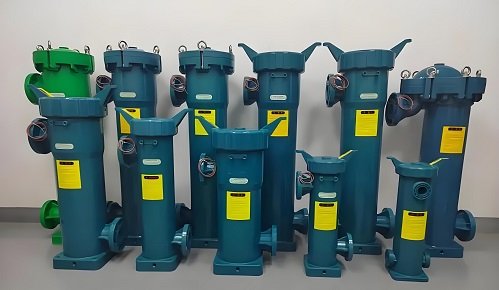
Product Introduction
A one-piece moulded bag filter is an advanced filtration device that integrates a seamless housing with a replaceable filter bag, designed to deliver efficient solid-liquid separation in industrial processes. Unlike traditional bag filters with multi-component housings, this technology features a monolithic moulded casing, eliminating joint leaks and enhancing structural integrity. The filter uses a cylindrical filter bag as the core element, capable of removing particles ranging from 0.5 to 200 microns, making it ideal for applications requiring high purity and reliable operation in sectors like water treatment, chemical processing, and food manufacturing.
Working Principle
- Filtration Process Flow
The one-piece design streamlines the filtration process:- Fluid Inlet: Contaminated fluid enters the filter through the side or top inlet, directed by the moulded housing to distribute evenly across the filter bag.
- Particle Interception: As fluid passes through the filter bag, solid particles are retained on the inner or outer surface (depending on flow direction), while the clarified fluid exits through the outlet.
- Differential Pressure Monitoring: A pressure gauge measures the drop across the bag. When pressure exceeds 0.1–0.3 MPa (indicating bag clogging), the filter bag is replaced to maintain efficiency.
- Bag Design and Filtration Mechanism
- Bag Construction: Made from polyester, polypropylene, or PTFE, with stitching-free moulded seams to prevent bypass. Common designs include:
- Depth Filtration Bags: Layered media for high dirt-holding capacity.
- Surface Filtration Bags: Membrane-coated for precise particle retention.
- Flow Dynamics: The one-piece housing ensures uniform flow distribution, minimizing dead zones and maximizing bag utilization.
- Bag Construction: Made from polyester, polypropylene, or PTFE, with stitching-free moulded seams to prevent bypass. Common designs include:
- Bag Replacement Protocol
- Quick-Change Design: The one-piece housing features a hinged cover or clamp ring, enabling bag replacement in <5 minutes without tools.
- Sanitary Design: In food-grade applications, the smooth interior surface meets 3-A Sanitary Standards, with no crevices for microbial growth.
Application Scenarios
- Monolithic Housing Advantages
- Material Options:
- Polypropylene (PP): For corrosive fluids (pH 1–14), temperature ≤80°C.
- Stainless Steel (316L): For high-pressure (up to 1.6 MPa) and high-temperature (≤150°C) applications.
- Moulding Technology: Injection moulding for PP housings ensures consistent wall thickness, while stainless steel housings use seamless welding to eliminate leak paths.
- Material Options:
- Filter Bag Integration
- Support Basket: A perforated stainless steel basket inside the housing supports the bag, preventing collapse under pressure.
- Bag Locking Mechanism: A top collar or snap ring secures the bag to the housing inlet, ensuring a tight seal and preventing unfiltered fluid bypass.
- Safety and Monitoring Features
- Explosion-Proof Options: Stainless steel housings with grounding studs for flammable fluid applications.
- Integrated Sensors: Some models include:
- Pressure transmitters for remote monitoring.
- Bag rupture detectors that trigger alarms if filtration efficiency drops suddenly.
Technical Advantages
- Leakage Prevention
- The one-piece moulded housing reduces leak points by 70% compared to flanged designs, validated by dye penetration tests showing <0.1% fluid bypass.
- High Filtration Efficiency
- Depth-loaded bags can hold up to 25 kg/m² of dirt, outperforming cartridge filters by 3–5 times in dirt-holding capacity.
- Cost-Effectiveness
- Bag replacement costs are 30–50% lower than cartridge filters, with faster change-out times reducing labor costs. A case study in a pharmaceutical plant showed $80,000 annual savings.
- Space Optimization
- The compact one-piece design occupies 40% less floor space than multi-housing systems, ideal for retrofitting in tight industrial settings.
Maintenance and Operation Guidelines
- Routine Inspections
- Daily: Check pressure gauges; replace bags when differential pressure exceeds 0.2 MPa.
- Monthly: Inspect housing for corrosion (stainless steel) or stress cracks (PP), especially in high-temperature applications.
- Bag Replacement Best Practices
- Cleaning Protocol: Rinse the housing interior with deionized water before installing a new bag to prevent cross-contamination.
- Bag Handling: Use anti-static gloves when installing PTFE bags to avoid static discharge that could damage the membrane.
- Performance Optimization
- Flow Rate Control: Maintain fluid velocity <1.5 m/s to prevent bag damage and ensure even filtration.
- Pre-Filtration Consideration: Use a 50-micron pre-filter in highly contaminated streams to extend main bag life by 2–3 times.
Conclusion
If you are interested in this product or have any questions, please feel free to contact us at any time.