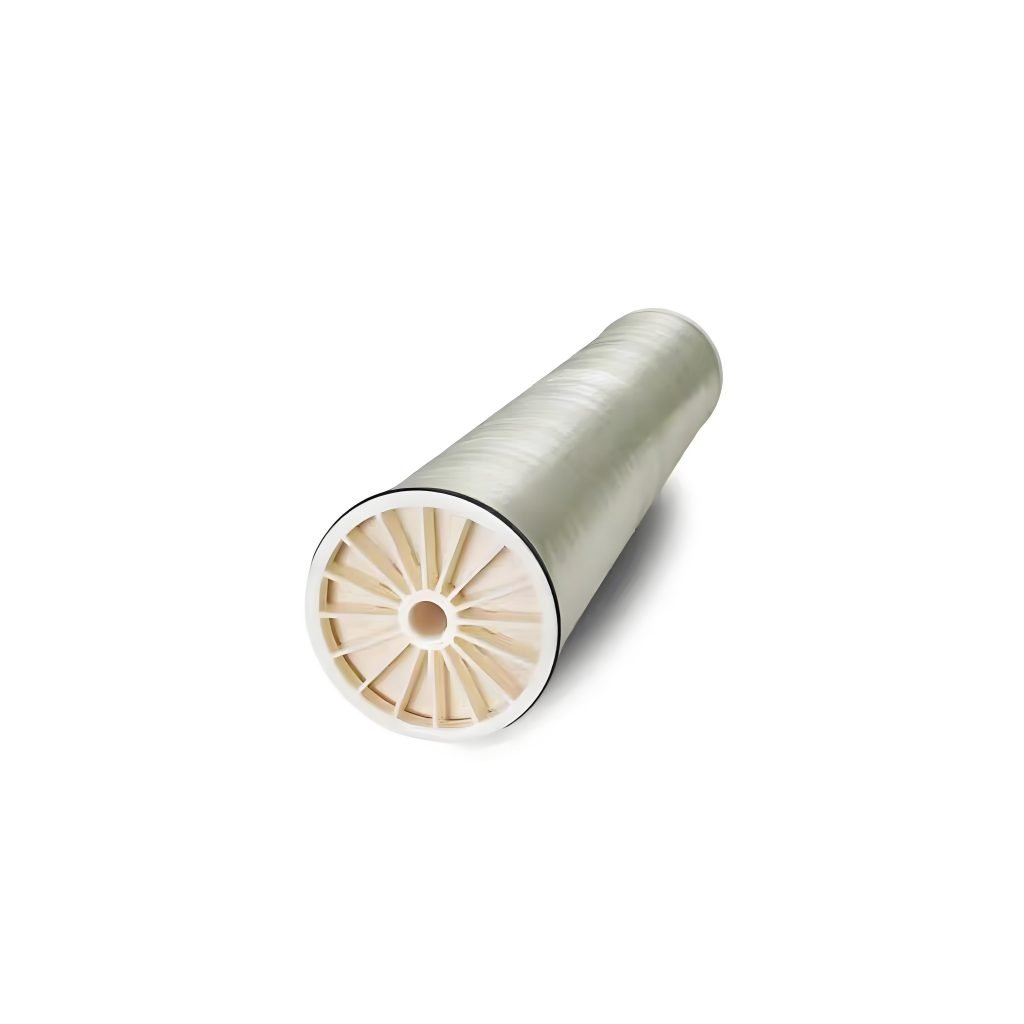
Product Introduction
The BW30-400 reverse osmosis (RO) membrane stands as a testament to advanced filtration engineering, specifically crafted for brackish water treatment with a focus on unparalleled salt rejection and water productivity. Manufactured by DuPont (formerly Dow FilmTec), this spiral-wound membrane leverages aromatic polyamide thin-film composite (TFC) technology to achieve over 99.5% rejection of dissolved salts while maintaining a robust water flux of approximately 10,000 gallons per day (37.8 m³/d). Engineered for municipal water supplies, industrial processes, and desalination pre-treatment, the BW30-400 balances high performance with energy efficiency, setting a global standard for reliability in water purification systems.
Working Principle
- Core Reverse Osmosis Mechanisms
The BW30-400 operates on the principle of reverse osmosis, where hydraulic pressure overrides natural osmotic pressure to drive water through a semi-permeable membrane, leaving salts and contaminants behind. Key operational principles include:- Semi-Permeable Barrier Functionality: The polyamide active layer allows selective water passage via nano-porous structures (pore size <0.0001 microns), rejecting ions, colloids, and organic matter through size exclusion and electrostatic repulsion.
- Pressure-Driven Filtration: Operating within 150–400 psi (1.0–2.8 MPa), the membrane forces water from the feed side to the permeate side. Higher salt concentrations in the feed water necessitate increased pressure to maintain flux, underscoring the importance of pre-treatment for energy optimization.
- Osmotic Pressure Dynamics: The dense polyamide network enhances salt rejection, with divalent ions (e.g., Ca²⁺, Mg²⁺) rejected more efficiently (99+%) than monovalent ions (99.5+% for NaCl).
- Thin-Film Composite Architecture Details
- Active Layer Engineering: A cross-linked polyamide layer, formed via interfacial polymerization, provides the primary salt rejection capability and resistance to chemical degradation.
- Support Layer Structure: A microporous polysulfone substrate offers mechanical stability without compromising water flow rates.
- Feed Spacer Design: A polypropylene mesh maintains turbulent flow in the feed channel, reducing concentration polarization and minimizing fouling risks.
- Operational Parameters and Limitations
- pH Stability Range: Functions effectively between pH 2–11, with short-term tolerance to pH 12 during cleaning procedures.
- Temperature Dependence: Optimal performance at 25°C, with flow decreasing by ~1% for each °C below this threshold; maximum allowable temperature is 45°C.
- Chlorine Sensitivity: Free chlorine exposure >0.1 ppm degrades the polyamide layer, requiring pre-treatment with dechlorination agents (e.g., sodium bisulfite) or activated carbon.
Structural Design and Engineering Innovations
- Spiral-Wound Module Configuration
- Membrane Leaf Construction: Multiple membrane leaves (active layer + support layer) are wound around a perforated central tube, forming a cylindrical element:
- Feed Channel: Axial flow through the spacer ensures uniform contact with the membrane surface, promoting even filtration.
- Permeate Collection System: Purified water spirals into the central tube, minimizing pressure loss and ensuring efficient water recovery.
- Physical Dimensions: 8-inch diameter x 40-inch length (203 mm x 1016 mm) with 400 ft² (37.2 m²) of effective membrane area, optimizing space utilization in filtration systems.
- Membrane Leaf Construction: Multiple membrane leaves (active layer + support layer) are wound around a perforated central tube, forming a cylindrical element:
- Material Science Breakthroughs
- Polyamide Active Layer: Engineered for enhanced cross-link density, balancing high salt rejection with hydrophilic properties to promote water flux.
- GRP Pressure Vessel: Glass-reinforced polyester housing withstands up to 600 psi (4.1 MPa), with UV-resistant coatings for outdoor installations and chemical resistance.
- Anti-Fouling Surface Modification: Surface chemistry adjustments reduce adsorption of organic matter and colloids, extending the interval between cleanings.
- Flow Dynamics Optimization
- Turbulence Enhancement: The feed spacer’s geometry promotes cross-flow velocities >1 m/s, minimizing particulate deposition and maintaining consistent filtration efficiency.
- Permeate Channel Design: Smooth internal pathways reduce resistance, ensuring uniform water collection across the membrane’s surface area.
Application Scenarios
- Municipal Water Treatment Landscapes
- Drinking Water Production: In regions with brackish groundwater, the BW30-400 reduces TDS from 1,000–3,000 ppm to <50 ppm. A case study in Jordan demonstrated its efficacy in reducing fluoride from 1.8 ppm to <1.0 ppm, meeting WHO drinking water standards.
- Wastewater Reclamation: Treats secondary effluent to non-potable standards, achieving COD removal >90% and turbidity <0.1 NTU for industrial reuse in cooling towers or irrigation.
- Industrial Process Water Applications
- Power Generation Sector: Purifies boiler feed water, removing silica (<0.5 ppm) and dissolved solids to prevent heat exchanger scaling, leading to 15–20% savings in chemical treatment costs for a 200 MW power plant.
- Pharmaceutical Manufacturing: Produces water for injection (WFI) with conductivity <1.3 μS/cm, adhering to USP standards for drug formulation and equipment cleaning.
- Desalination and Water Reuse
- Seawater RO Pre-Filtration: Used ahead of seawater membranes, the BW30-400 reduces silt density index (SDI) from 4–6 to <3, extending the life of downstream seawater RO elements by 30–40% in coastal desalination plants.
- Brackish Water Desalination: Achieves 80–85% recovery rates in brackish water systems, with energy consumption as low as 0.6–1.0 kWh/m³, depending on feed water salinity.
Technical Advantages and Performance Metrics
- Superior Salt Rejection Efficiency
- Maintains >99.5% NaCl rejection at standard operating pressures, outperforming conventional cellulose acetate membranes by 10–15% in divalent ion removal.
- Consistently rejects >99% of calcium and magnesium ions, critical for preventing scaling in downstream equipment.
- High Water Productivity and Flux
- Delivers 26 gpd/ft² (10.2 L/m²·h) at 25°C and 200 psi (1.4 MPa), a 25–30% higher flux than older-generation RO membranes, enabling 20% smaller system footprints.
- Operational Flexibility and Resilience
- Adapts to feed water TDS ranging from 500–10,000 ppm and pH 2–11, performing reliably in challenging water sources like industrial wastewater and agricultural runoff.
- Withstands short-term operational upsets, such as sudden turbidity spikes or minor chemical fluctuations, without significant performance degradation.
- Cost-Effectiveness and Longevity
- Operates for 3–5 years with proper pre-treatment, reducing lifecycle costs by 20–30% compared to lower-performance membranes. A food processing plant in Arizona reported $80,000 in savings over a 3-year period.
Maintenance and Operational Best Practices
- Comprehensive Pre-Treatment Protocols
- Particle Filtration: 5-micron cartridge filters remove suspended solids to prevent membrane abrasion and channel blockages.
- Chlorine Scavenging: Sodium bisulfite dosing (3–5 ppm) reduces free chlorine to <0.05 ppm, verified by on-line ORP sensors.
- Scale Inhibition: Anti-scalant injection (2–5 ppm polyphosphate) prevents calcium sulfate and carbonate scaling at recovery rates >75%.
- Proactive Cleaning and Maintenance
- Cleaning Triggers: Initiate when pressure drop increases by 15%, flow decreases by 10%, or salt rejection declines by 5%.
- Targeted Cleaning Formulations:
- Organic Fouling: 2% citric acid + 0.1% SDS at pH 3–4 for 60 minutes.
- Biofouling: 0.5% sodium hypochlorite at pH 10 for 30 minutes, followed by a citric acid rinse.
- Inorganic Scaling: 1–2% sodium hydroxide with EDTA at pH 10–11 for 90 minutes.
- Cleaning Frequency: Every 4–8 months in typical applications, extendable to 12 months with advanced pre-treatment (e.g., ultrafiltration).
- Operational Optimization Strategies
- Recovery Rate Management: Maintain <80% recovery for feed water >3,000 ppm TDS to avoid concentrate scaling.
- Temperature Compensation: Adjust pressure by 3 psi/°C (0.02 MPa/°C) to maintain constant flux amid seasonal temperature variations.
- Flux Control: Avoid exceeding 1.0 gpm/ft² (1.6 L/m²·h) to prevent irreversible fouling and membrane compaction.
Conclusion
The BW30-400 reverse osmosis membrane exemplifies the pinnacle of RO technology, integrating exceptional salt rejection, high water productivity, and operational resilience. Its thin-film composite architecture and spiral-wound design make it indispensable in water-scarce regions and industries demanding high-purity water. As global water challenges intensify, the BW30-400’s role in sustainable water management—through efficient brackish water treatment, wastewater recycling, and energy-efficient desalination—becomes increasingly critical. Future innovations, such as nanocomposite anti-fouling coatings and AI-driven predictive maintenance systems, promise to further enhance its performance, solidifying its status as a cornerstone of modern water purification and a catalyst for sustainable industrial practices.
If you are interested in this product or have any questions, please feel free to contact us at any time.