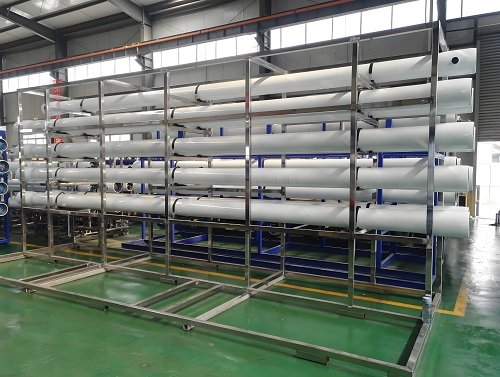
Product Introduction
Reverse osmosis (RO) systems have emerged as a cornerstone in water purification, addressing diverse industrial and municipal needs with high efficiency. This article delves into the technical framework, applications, and performance of RO systems, leveraging insights from design, operation, and real-world implementation.
Core Technology: How RO Systems Work
At the heart of an RO system lies the RO membrane, a semi – permeable barrier mimicking biological membranes. Typically crafted from (polymeric materials) like aromatic polyamide composites, these membranes feature surface pores ranging from 0.5–10nm. The system operates on the principle of pressure – driven separation: under high pressure, water molecules permeate the membrane, while dissolved salts, colloids, and contaminants are left behind.
Key components of a standard RO process (as shown in the workflow) include:
- Pretreatment Stages: Raw water undergoes multi – media filtration, activated carbon filtration, and security filtration to remove sediments, organics, and particles, preventing membrane fouling.
- RO Membrane Units: Divided into single – stage and double – stage configurations, they achieve desalination rates of ≥97% (single – stage) and ≥99% (double – stage), respectively.
- Post – treatment: UV sterilization ensures microbial safety, and pH adjustment optimizes water quality for end – use.
Applications Across Industries
RO systems deliver value across a wide spectrum of sectors:
- Industrial Pure Water: Used in electronics, pharmaceuticals, and food production, they generate ultrapure water (conductivity ≤5μs/cm for double – stage RO) critical for sensitive processes like semiconductor manufacturing.
- Wastewater Reclamation: In textile, chemical, and power industries, RO systems concentrate and recycle valuable substances from wastewater, reducing environmental impact and operational costs.
- Desalination: Effective for brackish and seawater desalination, they provide potable water in regions with limited freshwater resources, meeting WHO drinking water standards.
Performance Highlights and Advantages
RO systems boast several technical strengths:
- High Desalination Efficiency: Single – element membranes achieve ≥99% salt rejection, with double – stage systems reaching conductivity as low as 2μs/cm, removing over 99% of dissolved salts, organics, and microbes.
- Cost – Effective Operation: Compared to ion – exchange systems, RO reduces chemical consumption (e.g., resin regeneration) and wastewater discharge by up to 75%, lowering long – term operational costs.
- Stability and Automation: Equipped with PLC – based controls, systems auto – shut down during faults, ensuring stable water quality even with fluctuating raw water conditions.
Technical Specifications and Design Considerations
Key parameters define system capabilities:
- Treatment Efficiency: For tap water sources, single – stage RO produces water with conductivity ≤30μs/cm; double – stage, ≤5μs/cm.
- Operational Limits: Maximum feed water SDI (silt density index) <5, operating pressure up to 600psi (41bar), and temperature ≤35°C.
- Flexibility: Systems range from 0.5m³/h to 150m³/h, with customizable rack materials (stainless steel or epoxy – coated carbon steel) and membrane configurations.
Future Trends and Innovation
As water scarcity and quality demands grow, RO technology evolves:
- Membrane Innovation: New materials (e.g., graphene – enhanced composites) aim to boost flux and fouling resistance, extending membrane lifespan.
- Smart Integration: AI – driven predictive maintenance will optimize cleaning cycles, reducing downtime and energy use.
- Sustainability Focus: Hybrid systems combining RO with energy – recovery devices (e.g., pressure exchangers) cut energy consumption by 30–40%, aligning with global decarbonization goals.
Conclusion
In conclusion, RO systems represent a mature yet dynamic solution for water purification, balancing efficiency, cost – effectiveness, and adaptability. From industrial pure water to large – scale desalination, their role in securing water resources and enabling sustainable operations is indispensable. As technology advances, these systems will continue to set new benchmarks in water treatment performance.
If you are interested in this product or have any questions, please feel free to contact us at any time.