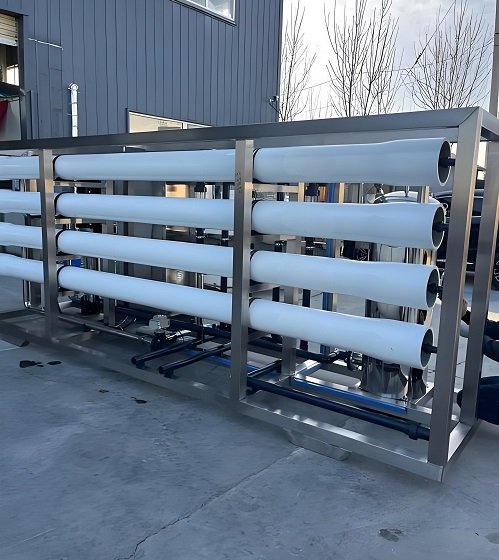
Product Introduction
Reverse osmosis (RO) systems represent a cornerstone of modern water treatment, leveraging advanced membrane technology to address diverse industrial, commercial, and municipal water purification needs. This article provides a comprehensive overview of RO systems, exploring their working principles, application scope, performance advantages, and technical specifications, with insights drawn from design, operation, and real – world implementation.
Working Principles of RO Systems
- Pretreatment: Raw water undergoes multi – media filtration (removing sediments), activated carbon filtration (adsorbing organics and residual chlorine), and security filtration (blocking fine particles). This step prevents membrane fouling, ensuring long – term efficiency.
- Pressurization & Membrane Separation: A high – pressure pump forces pretreated water through the RO membrane. Water molecules permeate the membrane, while salts and contaminants are rejected, producing two streams: purified “permeate” and concentrated “brine.”
- Post – treatment: Optional steps (e.g., UV sterilization, pH adjustment) refine water quality for end – use, such as ultrapure water production or potable supply.
Diverse Industrial and Municipal Applications
- Industrial Pure Water: Critical for electronics (semiconductor manufacturing), pharmaceuticals (drug formulation), and food production. Double – stage RO systems achieve conductivity as low as 2μs/cm, meeting strict purity standards for sensitive processes.
- Wastewater Reclamation: In textile, chemical, and power industries, RO recycles water by concentrating valuable substances (e.g., dyes, solvents) and reducing wastewater discharge. This cuts operational costs and environmental impact.
- Desalination: Transforms brackish/seawater into potable water for coastal or arid regions, adhering to WHO drinking water guidelines. RO eliminates 99%+ of salts, providing a reliable freshwater source.
- Municipal Water Supply: Complements traditional treatment (e.g., sedimentation, disinfection) to remove trace contaminants, ensuring clean water for households and public facilities.
Performance Advantages of RO Systems
- High Desalination Efficiency: Single – stage membranes achieve ≥99% salt rejection; double – stage systems reach 99.5%+, reducing conductivity to ≤5μs/cm. This ensures purified water meets stringent quality standards.
- Cost – Effective Operation: Compared to ion – exchange systems, RO cuts chemical consumption (e.g., no resin regeneration) and wastewater discharge by up to 75%. High water recovery (up to 75%) lowers long – term operational costs.
- Stability & Automation: PLC – controlled systems auto – adjust to fluctuating raw water conditions (e.g., pressure, contaminant levels). Fault detection (e.g., abnormal pressure drops) triggers shutdowns, ensuring consistent water quality.
- Compact Design: Modular systems fit diverse footprints, from small – scale skids (0.5m³/h) to large – scale plants (150m³/h). Rack materials (stainless steel, epoxy – coated carbon steel) adapt to corrosive or budget – conscious environments.
Technical Specifications and Design Flexibility
- Key parameters define RO system capabilities:
- Treatment Efficiency: For tap water, single – stage RO produces ≤30μs/cm conductivity; double – stage systems achieve ≤5μs/cm. This suits applications from industrial ultrapure water to municipal supply.
- Operational Limits: Maximum feed water SDI (silt density index) <5, operating pressure up to 600psi (41bar), and temperature ≤35°C. These prevent membrane damage and ensure consistent performance.
- Customization: Systems scale from 0.5m³/h (small industries) to 150m³/h (municipal plants). Membrane configurations (e.g., 1:1, 2:1) and rack materials adapt to specific site needs, balancing cost and durability.
Future Trends in RO Technology
- Membrane Advancements: Graphene – enhanced composites promise higher flux, fouling resistance, and longer lifespans. These could reduce energy use and maintenance costs.
- AI – Driven Optimization: Machine learning predicts fouling, optimizing cleaning cycles and reducing downtime. Real – time data analytics (e.g., pressure, flow rates) enhance system efficiency.
- Sustainability Upgrades: Energy – recovery devices (e.g., pressure exchangers) cut energy consumption by 30–40%, aligning RO with global decarbonization goals. Hybrid systems (RO + UV, RO + ozonation) improve contaminant removal for complex water sources.
Conclusion
Reverse osmosis systems combine scientific precision, operational flexibility, and cost – effectiveness to address critical water treatment challenges. From industrial ultrapure water to municipal supply and desalination, their role in securing clean water is indispensable. As technology evolves—with smarter controls, advanced membranes, and sustainable designs—RO systems will continue to set benchmarks in water purification, supporting a more water – secure future for industries and communities worldwide.
If you are interested in this product or have any questions, please feel free to contact us at any time.