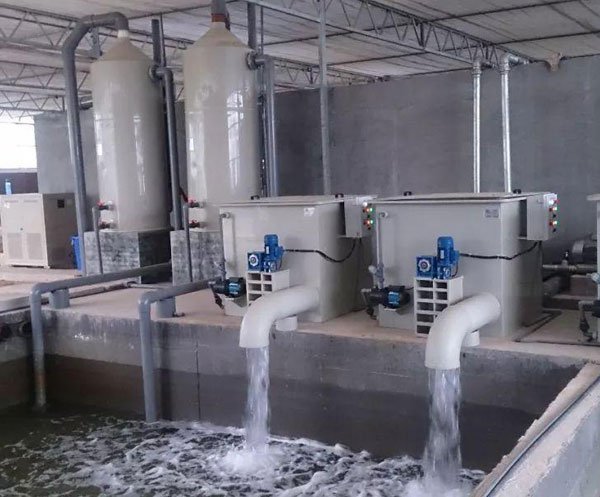
The multi-media sand filter is mainly composed of the following parts:
Tank
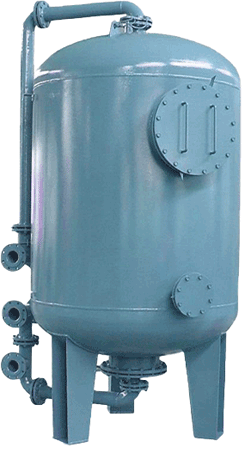
The tank is the outer shell of the multi-media sand filter, which plays the role of containing the filter medium and the filtered water. The tank is usually made of carbon steel, which has high strength and can withstand a certain pressure to ensure that the filtration process is carried out under appropriate pressure conditions. In order to prevent the carbon steel tank from being corroded, the inside and outside will be treated with corresponding anti-corrosion treatment, such as coating anti-corrosion paint. In addition, some multi-media sand filter tanks are made of stainless steel, which has better corrosion resistance and is especially suitable for occasions with high water quality requirements or water quality with certain corrosiveness. The shape of the tank is generally cylindrical, which can make the water flow more evenly distributed in the tank, which is conducive to filtration. At the same time, the tank is also equipped with various interfaces, including water inlet, water outlet, backwash inlet, backwash outlet, exhaust port and sewage outlet. The position and size of these interfaces are carefully designed to ensure that water can enter and exit the tank according to the predetermined process and perform backwashing operations.
Filter medium
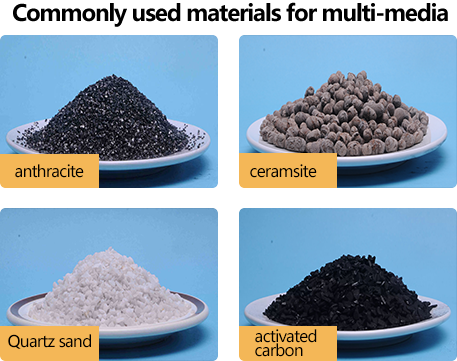
This is the core part of the multi-media sand filter. Multi-media sand filters usually use a variety of filter media with different particle sizes and materials to achieve effective filtration of particles of different sizes and pollutants of different properties. Common filter media include quartz sand, anthracite, manganese sand, etc. Quartz sand is a mineral with high hardness and stable chemical properties. Its particle size has a variety of options, generally ranging from 0.5-1.2mm. Quartz sand with coarser particle size is mainly used to intercept larger particles of impurities, such as silt, suspended matter, etc.; quartz sand with finer particle size can further filter smaller particles. Anthracite has a lower density. Compared with quartz sand, its particle surface is relatively rough and has a larger specific surface area, which can adsorb some organic matter and colloids in water. Manganese sand is mainly used to remove metal ions such as iron and manganese in water. When there is iron and manganese in water, manganese sand will convert them into insoluble precipitates through redox reactions, thereby achieving the purpose of removal. These filter media are loaded in layers in the tank, usually in the order of particle size from large to small and density from large to small. For example, the bottom layer is coarse-grained quartz sand, the upper layer is anthracite, and the top layer may be fine-grained quartz sand or other special filter media. This layered loading method allows water to pass through different filter layers in sequence when passing through the filter media, achieving gradual filtration and improving the filtration effect.
Water distribution system
The main function of the water distribution system is to evenly distribute the water entering the tank above the filter media to ensure that the water can pass through the filter media evenly. If the water distribution is uneven, some filter media will be overused, while some filter media will not be fully utilized, affecting the filtration effect and the service life of the filter media. The water distribution system generally includes an inlet pipe and a water distributor. The inlet pipe introduces water into the tank, and the water distributor is installed at the end of the inlet pipe. It usually adopts a porous structure or a special nozzle design. For example, some water distributors are disc-shaped structures with many small holes. After water enters the water distributor from the water inlet pipe, it is evenly sprayed on the upper layer of the filter medium through these small holes. Some water distributors are designed with rotating nozzles, and the water is evenly distributed in the entire filter area through the rotation of the nozzle.
Water collection system
Corresponding to the water distribution system, the water collection system is responsible for collecting water filtered by the filter medium and leading it out of the tank. The water collection system mainly includes a water collector and an outlet pipe. The water collector is usually located below the filter medium. It has many forms, such as porous plates and filter caps. A porous plate is a flat plate with many small holes, which allows the filtered water to be collected through the small holes to the space below, and then flow out through the outlet pipe. The filter cap is a small device with gaps or small holes. It is installed on the water collection pipe. The filtered water enters the water collection pipe through the filter cap and then flows into the outlet pipe. The design of the water collection system should ensure that the filtered water can be collected quickly and efficiently, while preventing the filter medium from entering the outlet pipe and affecting the water quality.
Backwash system
As the filtration process proceeds, impurities will gradually accumulate on the surface of the filter medium, resulting in increased filtration resistance and decreased filtration effect. The backwash system is set up to remove impurities on the surface of the filter medium. The backwash system mainly includes a backwash inlet pipe, a backwash outlet pipe and a backwash pump. When backwashing is required, the backwash pump starts and sends the backwash water into the tank through the backwash inlet pipe. The flow direction of the backwash water is opposite to that of the water during normal filtration. It washes the filter medium from bottom to top, flushes the impurities accumulated on the surface of the filter medium, and then discharges them from the tank through the backwash outlet pipe. The intensity and time of the backwash can be adjusted according to factors such as the type of filter medium and usage. Generally speaking, the intensity of the backwash should be moderate. Too strong may cause the filter medium to be lost, and too weak may not effectively remove impurities.
Support layer
The support layer is located at the bottom of the filter medium. It supports the filter medium and prevents the filter medium from sinking or deforming under the impact of water flow and gravity. The support layer is usually made of gravel and other materials. The gravel has a larger particle size, generally around 2-4mm. It has high strength and stability and can provide uniform support for the filter medium on the upper layer. At the same time, the gaps between the gravel can also allow the filtered water to pass smoothly and enter the water collection system.
Valve and piping system
Valve and piping system are important components of multi-media sand filters. They control the inlet and outlet and flow direction of water. Valves include inlet valves, outlet valves, backwash inlet valves, backwash outlet valves, and sewage valves. The opening and closing status of these valves determines whether the multi-media sand filter is in normal filtering state, backwashing state or other operating state. The inlet valve is used to control the raw water entering the tank, the outlet valve is used to control the filtered water flowing out of the tank, the backwash inlet valve and the backwash outlet valve are used to control the backwash water entering and discharging, respectively, and the sewage valve is used to discharge impurities and sewage in the tank during backwashing or equipment maintenance. The piping system includes various inlet and outlet pipes, backwash pipes and sewage pipes, etc. Their pipe diameters, materials and connection methods should be designed according to factors such as the water volume, pressure requirements and water quality of the multi-media sand filter. The pipe material is generally carbon steel or UPVC. Carbon steel pipes have high strength and are suitable for high-pressure systems; UPVC pipes are corrosion-resistant and easy to install, and are suitable for systems with general pressure and water quality conditions.