Introduce:
In the field of water treatment, the multi – media filter stands as a cornerstone technology, widely utilized to purify water by removing suspended solids, colloidal particles, and other impurities. As water sources, whether from municipal supplies, industrial wastewater, or natural reservoirs, often contain various contaminants that can hinder industrial processes, damage equipment, or pose health risks, the need for efficient filtration systems is paramount. The multi – media filter addresses this need through a layered approach, employing different types of filter media to achieve a higher level of filtration efficiency compared to single – media filters.
This type of filter has a long history of application, evolving with advancements in material science and engineering to meet the increasingly strict water quality standards across diverse industries. From small – scale residential water treatment to large – scale industrial operations, multi – media filters play a vital role in ensuring that water meets the required purity levels for its intended use, be it for drinking, manufacturing, or agricultural purposes.
Advantages & Features
2.1 Enhanced Filtration Efficiency
One of the key advantages of multi – media filters is their enhanced filtration efficiency. By using a combination of different filter media with varying particle sizes and densities, these filters can trap a wider range of contaminants. The larger, less dense media at the top of the filter bed captures larger particles, while the smaller, denser media at the bottom trap finer particles. This layering effect ensures that the entire filter bed is utilized effectively, reducing the chance of clogging and extending the filter run time. For example, in a typical multi – media filter with anthracite, sand, and gravel, the anthracite layer catches large suspended solids, the sand layer traps medium – sized particles, and the gravel provides support while capturing any remaining fine particles.
2.2 Longer Service Life of Filter Media
Compared to single – media filters, multi – media filters offer a longer service life for the filter media. The layered arrangement allows for more uniform distribution of the contaminant load across the entire bed, rather than concentrating it on the top layer. This reduces the wear and tear on individual media particles, as each layer is responsible for capturing a specific range of particles. As a result, the need for media replacement is less frequent, leading to lower maintenance costs and reduced downtime.
2.3 High Flow Rate Capacity
Multi – media filters are designed to handle high flow rates, making them suitable for applications where large volumes of water need to be treated quickly. The combination of media with different porosities allows water to pass through the filter bed with relatively low pressure drop, even at high flow rates. This is particularly beneficial in industrial settings such as power plants, where a continuous and high – volume supply of treated water is essential for cooling systems and other processes.
2.4 Versatility in Applications
These filters exhibit great versatility, being able to treat various types of water sources, including surface water, groundwater, and industrial wastewater. They can be customized by selecting different combinations of filter media to target specific contaminants. For instance, if the water contains high levels of organic matter, activated carbon can be added to the media mix to enhance adsorption. If heavy metals are a concern, certain ion – exchange resins can be incorporated into the filter bed.
2.5 Simple Operation and Maintenance
Multi – media filters are relatively easy to operate and maintain. The filtration process is automatic in most cases, controlled by a system that monitors the pressure drop across the filter bed. When the pressure drop reaches a pre – set threshold, indicating that the filter is becoming clogged, a backwashing cycle is initiated to clean the media. Backwashing involves reversing the flow of water through the filter bed, which dislodges the trapped contaminants and flushes them out of the filter. This process is straightforward and can be completed without the need for extensive manual intervention.
Structure Specification
3.1 Filter Vessel
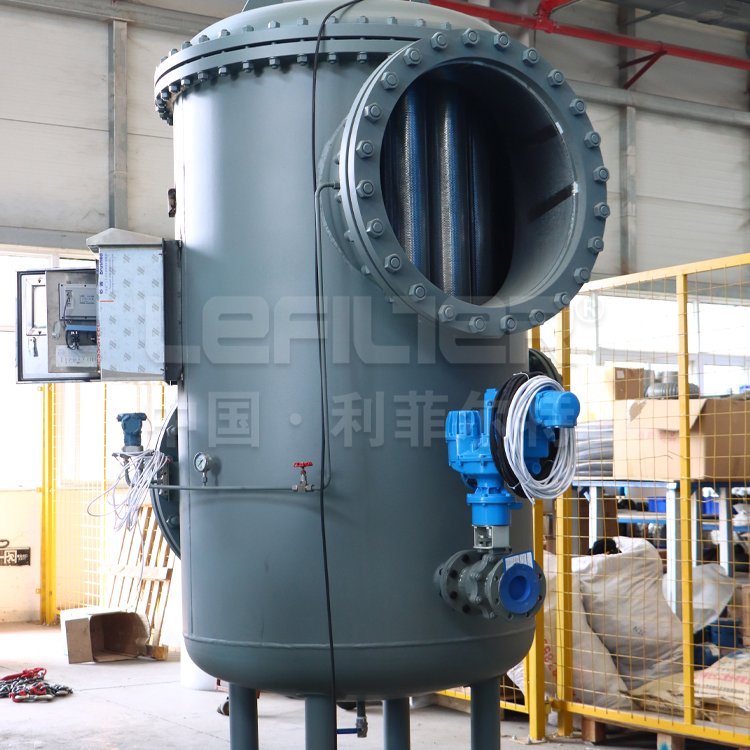
The filter vessel is the main structural component of the multi – media filter, providing a containment space for the filter media and the water being treated. It is typically constructed from materials such as carbon steel (with corrosion – resistant linings), stainless steel, or fiberglass – reinforced plastic (FRP), depending on the application and the type of water being filtered. The vessel can be either vertical or horizontal in design. Vertical vessels are more common in smaller to medium – sized systems, while horizontal vessels are used for larger flow rates. The size of the vessel is determined by factors such as the required flow rate, the type of media used, and the desired filter run time between backwashes.
3.2 Filter Media Layers
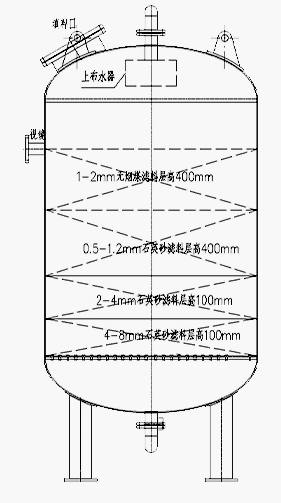
The filter media is arranged in distinct layers within the vessel, with each layer having specific characteristics. The most common media combination is anthracite coal, silica sand, and gravel, but other media can be added based on specific treatment needs.
- Anthracite Coal: This is the top layer, with a larger particle size (typically 1.2 – 2.5 mm) and lower density compared to the other media. It is effective at capturing large suspended solids and has good adsorption properties for organic matter.
- Silica Sand: The middle layer consists of silica sand with a smaller particle size (usually 0.5 – 1.2 mm) than anthracite. It traps medium – sized particles that pass through the anthracite layer.
- Gravel: The bottom layer is made up of gravel with larger particle sizes (ranging from 2 – 64 mm). Its primary function is to support the upper media layers and prevent them from being washed out during backwashing. It also helps to distribute the water evenly across the filter bed during both filtration and backwashing.
In some cases, additional media layers may be included. For example, activated alumina can be added to remove fluoride, or manganese greensand to remove iron and manganese from the water.
3.3 Distribution and Collection Systems
To ensure uniform flow of water through the filter media, multi – media filters are equipped with distribution and collection systems. The inlet distribution system, located at the top of the filter vessel, spreads the incoming water evenly over the surface of the filter media, preventing channeling (uneven flow through the bed). Common types of inlet distributors include spray nozzles, perforated pipes, or weir troughs.
The collection system, located at the bottom of the vessel, collects the filtered water and directs it out of the filter. It also plays a crucial role in distributing the backwash water evenly during the cleaning cycle. Collection systems can be in the form of a false bottom with slots or a network of perforated pipes.
3.4 Control Valves and Piping
A set of control valves and piping is used to regulate the flow of water during filtration and backwashing. The main valves include the inlet valve (for raw water), outlet valve (for filtered water), backwash inlet valve (for backwash water), and backwash outlet valve (for discharging wastewater during backwashing). These valves can be manually operated in small systems or automatically controlled by a programmable logic controller (PLC) in larger, more sophisticated setups.
Working Principle
The working principle of a multi – media filter is based on the process of depth filtration, where water passes through a bed of filter media, and contaminants are trapped within the media matrix.
During the filtration cycle, raw water enters the filter vessel through the inlet distribution system and flows downward through the layers of filter media. As the water moves through the anthracite layer, large suspended particles are captured on the surface and within the pores of the media. The remaining water then passes through the silica sand layer, where smaller particles are trapped. The gravel layer at the bottom provides support and ensures that the finer media particles are not carried away with the filtered water. The filtered water is collected by the bottom collection system and exits the filter through the outlet valve.
Over time, the accumulation of contaminants in the filter media causes an increase in the pressure drop across the filter bed. When this pressure drop reaches a predetermined level (usually 0.5 – 1.0 bar), the filter initiates a backwashing cycle to clean the media. During backwashing, the flow of water is reversed. Backwash water (which can be filtered water from the system or clean water from an external source) enters the filter through the bottom collection system and flows upward through the media bed. This upward flow expands the media bed, causing the media particles to rub against each other, dislodging the trapped contaminants. The dirty backwash water, along with the contaminants, is discharged through the backwash outlet valve. After backwashing, a rinse cycle may be performed to remove any remaining contaminants and to settle the media bed back into its original position before the filtration cycle resumes.
Application
5.1 Municipal Water Treatment
Multi – media filters are widely used in municipal water treatment plants as a pre – treatment step to remove suspended solids, turbidity, and other particulate matter from raw water before it undergoes further treatment processes such as disinfection. This helps to improve the efficiency of subsequent treatment steps, such as reverse osmosis or chemical disinfection, by reducing the load on these systems.
5.2 Industrial Water Treatment
In various industries, multi – media filters are employed to treat process water, cooling water, and wastewater. For example, in the power industry, they are used to treat makeup water for boilers and cooling towers, preventing the accumulation of scale and corrosion caused by suspended solids. In the food and beverage industry, these filters help to ensure that the water used in production meets strict hygiene standards by removing contaminants that could affect the quality and safety of the final product.
5.3 Commercial and Institutional Facilities
Commercial buildings such as hotels, hospitals, and office complexes use multi – media filters to treat water for domestic use, including drinking, bathing, and laundry. They are also used in swimming pools to remove dirt, debris, and algae from the pool water, maintaining water clarity and hygiene.
5.4 Agricultural Irrigation
In agricultural applications, multi – media filters are used to treat irrigation water, removing sand, silt, and other particles that can clog sprinklers and drip irrigation systems. This helps to ensure uniform water distribution and improves the efficiency of irrigation, leading to better crop yields.
5.5 Aquaculture
Aquaculture facilities rely on multi – media filters to maintain water quality in fish tanks and ponds. By removing excess feed, fish waste, and other organic matter, these filters help to create a healthy environment for aquatic organisms, reducing the risk of disease and improving growth rates.