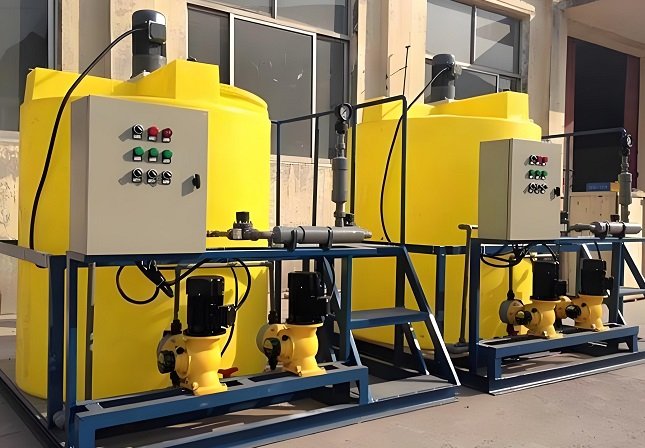
Product Introduction
An automatic chemical dosing device is a state-of-the-art industrial system engineered to deliver precise, automated, and responsive chemical injection across diverse applications, from water treatment to manufacturing processes. Unlike manual dosing, which suffers from inconsistency and human error, these systems leverage real-time data analysis, closed-loop control, and intelligent algorithms to maintain optimal chemical concentrations. By integrating sensors, programmable controllers, and high-precision pumps, they ensure that chemicals such as flocculants, disinfectants, or pH adjusters are delivered at the exact rate required, minimizing waste and maximizing process efficiency.
Working Principle
- Sensing and Process Monitoring
The device begins with a network of sensors that continuously monitor key parameters:- Flow Sensors: Ultrasonic or magnetic flow meters measure the volume of process fluid, forming the basis for proportional dosing.
- Analytical Sensors: pH electrodes, turbidity meters, or conductivity probes provide real-time data on fluid characteristics. For example, in wastewater treatment, an ORP (oxidation-reduction potential) sensor may trigger chlorine dosing to maintain disinfection efficacy.
- Environmental Sensors: Temperature and pressure sensors adjust dosing rates in response to changing process conditions.
- Intelligent Control Logic
A central processing unit (CPU) or PLC executes algorithms to calculate dosage:- Feedforward Control: Predicts dosage based on historical data and expected flow rates, ideal for stable processes.
- Feedback Control: Adjusts dosage in real time using sensor inputs. For instance, if a pH sensor detects alkalinity deviation, the system automatically increases acid injection.
- Adaptive Control: Learns from process variations, optimizing dosing parameters over time to account for seasonal or operational changes.
- Precision Dosing Execution
The actuation system comprises:- Metering Pumps: Diaphragm pumps for high accuracy (±1% flow control) or peristaltic pumps for corrosive chemicals, often equipped with variable frequency drives (VFDs) for speed adjustment.
- Valve Systems: Solenoid or motorized valves that open/close based on control signals, with anti-siphon and backflow prevention features.
- Mixing Mechanisms: Static mixers or in-line agitators ensure uniform chemical dispersion, preventing localized concentration spikes.
Core Components and Design Innovations
- Chemical Storage Modules
- Tank Systems: Constructed from HDPE, FRP, or 316L stainless steel, with capacities up to 50,000L, featuring:
- Level sensors with remote alarm capabilities (e.g., ultrasonic or guided wave radar).
- Heating jackets for temperature-sensitive chemicals like wax-based inhibitors.
- Agitation Systems: Mechanical stirrers or air spargers to prevent sedimentation in polymer solutions.
- Tank Systems: Constructed from HDPE, FRP, or 316L stainless steel, with capacities up to 50,000L, featuring:
- Dosing Pump Technologies
- Diaphragm Pumps: Hydraulically actuated with electronic stroke adjustment, suitable for flows from 0.01 L/h to 5,000 L/h.
- Electromagnetic Pumps: Brushless DC motors for low-power applications, ideal for small-scale dosing in laboratories.
- Pump Integration: Multiple pumps can be configured in parallel for redundancy or in series for staged dosing.
- Control and Automation Systems
- Human-Machine Interfaces (HMIs): Touchscreen panels displaying real-time trends, alarm logs, and dosage history.
- Cloud Connectivity: IoT gateways enabling remote access via SCADA systems or mobile apps (e.g., through MQTT or OPC UA protocols).
- Data Analytics: Built-in software that generates performance reports, such as chemical consumption trends and process efficiency metrics.
- Safety and Compliance Features
- Leak Detection: Linear sensors or point detectors that trigger emergency shutdowns in case of spills.
- Explosion Protection: Class I, Division 2 certified components for hazardous areas.
- Regulatory Compliance: Built-in counters and recorders to meet EPA, OSHA, or ISO standards for chemical usage documentation.
Industry Applications and Case Studies
- Municipal Water Treatment
- Case Study: Chlorine Dosing in Drinking Water
A city water plant implemented an automatic dosing system with residual chlorine sensors and flow-proportional control. The system reduced chlorine usage by 22% while maintaining residual levels between 0.3–0.5 mg/L, exceeding EPA standards. The PLC-based controller adjusted dosage in real time based on water demand, eliminating over-dosing during low-flow nights.
- Case Study: Chlorine Dosing in Drinking Water
- Oil & Gas Production
- Scale Inhibition in Pipelines
In a shale gas field, a dosing device injected a blend of polyacrylamides and phosphonates into production water. The system used pressure drop sensors to detect early scale formation, increasing dosage by 15% during peak production periods. This reduced pipeline blockages by 70%, saving $1.2M annually in maintenance costs.
- Scale Inhibition in Pipelines
- Pharmaceutical Manufacturing
- Buffer Solution Dosing in Bioreactors
A biopharmaceutical plant installed a sterile dosing system with peristaltic pumps and SIP (sterilize-in-place) capabilities. The system maintained pH at 7.2 ± 0.1 by injecting sodium hydroxide or hydrochloric acid, ensuring consistent cell growth and increasing protein yield by 18%.
- Buffer Solution Dosing in Bioreactors
Technical Advantages
- Precision and Repeatability
- Dosage accuracy: ±1–2% of setpoint, compared to ±10% in manual systems.
- Response time: <15 seconds for feedback control adjustments, critical in rapidly changing processes.
- Operational Efficiency
- Chemical savings: 20–40% reduction in usage, with payback periods typically 6–18 months.
- Labor cost reduction: 80% fewer manual interventions, freeing operators for higher-value tasks.
- Scalability and Flexibility
- Modular design allows easy expansion, with add-on modules for additional chemical streams or sensor inputs.
- Hot-swappable components (e.g., pump heads, sensors) enable maintenance without system shutdown.
- Environmental Impact
- Reduced chemical waste: 30–50% lower discharge of untreated chemicals, aligning with ISO 14001 standards.
- Energy efficiency: VFDs and low-power sensors consume 30% less electricity than traditional systems.
Maintenance and Operation Considerations
- Preventive Maintenance Schedules
- Monthly: Calibrate sensors using standard solutions (e.g., pH 4.01 and 7.00 buffers).
- Quarterly: Perform pump head inspections, replace diaphragms in reciprocating pumps, and clean strainers.
- Annual: Service VFDs, test emergency shutdown systems, and update controller firmware.
- Performance Optimization
- Data-Driven Adjustments: Analyze historical dosing data to identify patterns (e.g., seasonal variations in chemical demand).
- Predictive Maintenance: Use vibration sensors on pumps to forecast bearing wear, scheduling replacements before failures occur.
- Operator Training
- Regular workshops on HMI operation, alarm response, and basic troubleshooting, reducing downtime from operator error by 50%.
Conclusion
Automatic chemical dosing devices have evolved from simple metering systems to intelligent, connected solutions that define precision in industrial chemical management. Their ability to integrate real-time data, adaptive control, and modular design makes them indispensable in sectors where chemical accuracy directly impacts product quality, operational cost, and environmental compliance. As industries embrace Industry 4.0, these devices will continue to advance, combining AI-driven insights with sustainable engineering to redefine efficiency and responsibility in chemical application.
If you are interested in this product or have any questions, please feel free to contact us at any time.