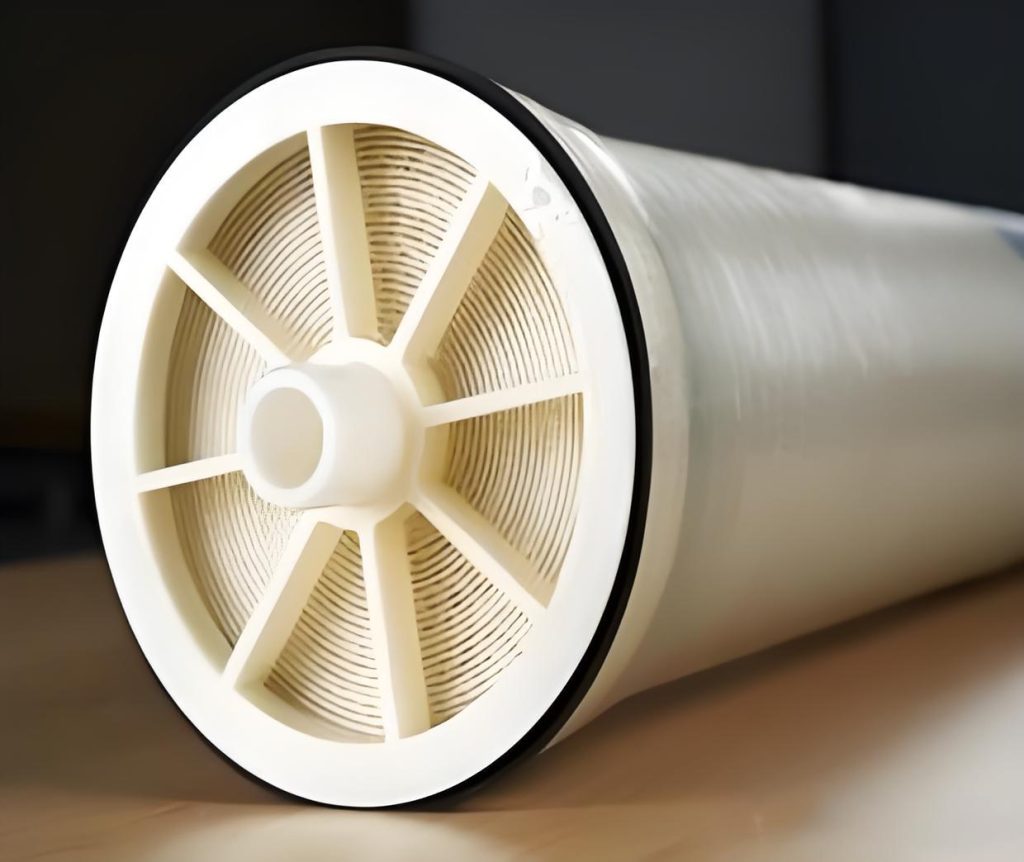
Product Introduction
The industrial-grade DOW BW30-400 IG brackish water reverse osmosis membrane designed for industrial water treatment applications. It maintains the same flow rate and salt rejection performance as the BW30-400 membrane while offering a more cost-effective solution for industrial applications. The BW30-400 IG element allows cleaning across a broad pH range (pH 1–13). In industrial water treatment systems, the BW30-400 IG serves as a direct replacement for the BW30-400.

Technical Specifications
| Parameter | Value/Description |
|---|---|
| Model | BW30-400 IG |
| Type | Industrial brackish water RO membrane (Integrated Array design) |
| Effective Membrane Area | 400 sq ft (37 m²) |
| Product Flow Rate | 10,500 GPD (39.7 m³/day) |
| Salt Rejection | ≥99.5% |
| Stable Salt Rejection | ≥99.0% (long-term operation) |
| Maximum Operating Pressure | 600 psi (41 bar) |
| Maximum Temperature | 45°C (113°F) |
| pH Tolerance Range | 2–11 (continuous operation), 1–12 (short-term cleaning) |
| Maximum Pressure Drop | 15 psi (1.0 bar) |
| Recommended Cleaning pH Range | 4–10 |
| Feed Flow Rate | 75 gpm (17 m³/h) |
| Feed Turbidity Requirement | <1 NTU |
| Free Chlorine Tolerance | <0.1 ppm |
| Dimensions (Diameter × Length) | 8 in × 40 in (203 mm × 1016 mm) |
| Weight | ~50 lbs (22.7 kg) |
Test conditions: 2,000 ppm NaCl, 225 psi (15.5 bar), 77°F (25°C), pH 8, 15% recovery.
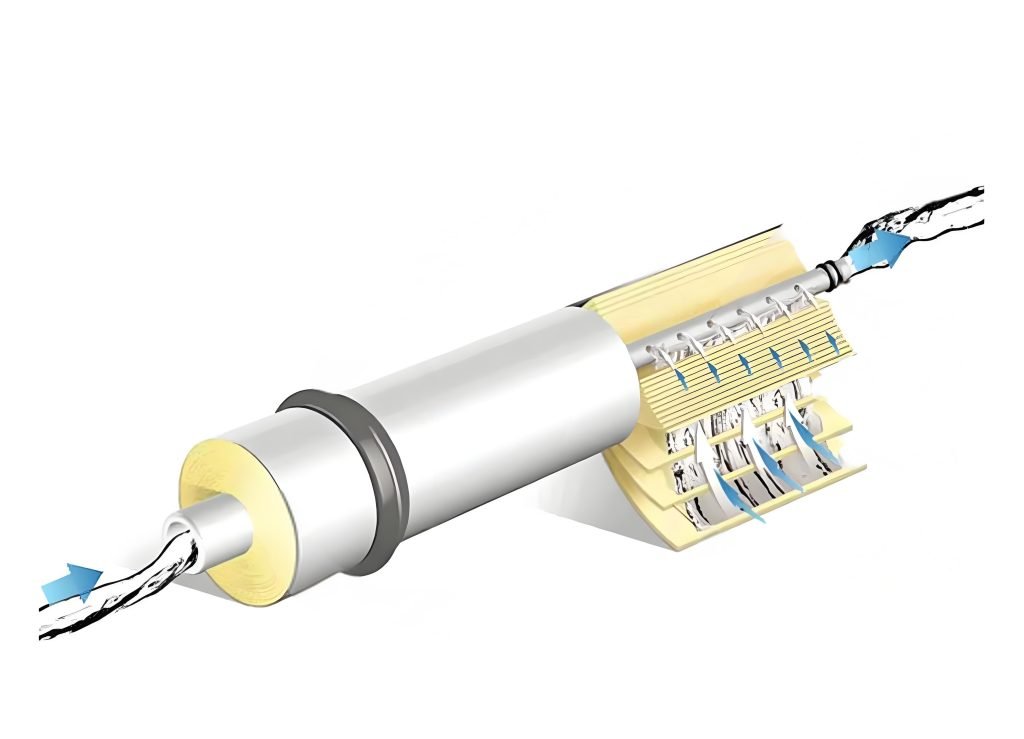
Working Process
- Feedwater Pretreatment
Raw water undergoes filtration (e.g., multi-media filtration, ultrafiltration) and chemical dosing (e.g., antiscalants, biocides) to meet RO feedwater requirements (e.g., turbidity <1 NTU, free chlorine <0.1 ppm). - Pressure-Driven Separation
- High-pressure pumps pressurize feedwater to 150–400 psi (depending on salinity and temperature), directing flow into the membrane element.
- The polyamide composite layer (semi-permeable membrane) allows water molecules to pass while rejecting:
- Dissolved salts (e.g., Na⁺, Cl⁻, Ca²⁺, Mg²⁺) with ≥99.5% salt rejection.
- Organics (molecular weight >100 Da), colloids, bacteria, and viruses.
- Product and Concentrate Streams
- Product water (permeate): Passes through the membrane into the central tube as purified, low-salinity water.
- Concentrate (reject stream): Carries rejected contaminants out of the element; partial recycling improves recovery.
- Energy Recovery and Discharge
- Concentrate can be processed through energy recovery devices (e.g., PX) to reduce system energy consumption.
- High-salinity concentrate must be discharged compliantly or further treated (e.g., evaporation crystallization).
Product Advantages
- High resistance to compaction, abrasion, and chemical degradation: Proprietary membrane materials and manufacturing ensure durability.
- Broad pH tolerance: Enables aggressive cleaning with standard acids/bases, reducing long-term operating costs.
- No pinhole defects: Flawless membrane surface without patches or repairs.
- Extended lifespan: Thicker, more uniform, and smoother active layer ensures long-term stability.
- High cleaning efficiency: Wider feed channels minimize fouling and enhance cleanability.
Applications in High-Flow Industrial Water Treatment
Electronics: Ultrapure water for semiconductor manufacturing.
Power: Boiler feedwater treatment to prevent scaling.
Pharmaceutical: High-purity water meeting GMP standards.
Chemical: High-salinity wastewater reuse to cut costs.

Other Application Areas
- Brackish water desalination: Treats groundwater or brackish water (TDS 500–10,000 ppm) for industrial or potable use.
- Wastewater reuse:
- Petrochemical/electroplating: Removes salts and heavy metals for recycling.
- Textile/dyeing: Decolorizes and desalinates for reuse.
- Municipal wastewater: Advanced purification for irrigation or industrial cooling.
- Food & beverage: Ensures water safety in dairy, beverage, and food processing.
- Seawater desalination pretreatment: Reduces load on downstream systems.
Conclusion
The DOW BW30-400 IG RO membrane delivers high efficiency (≥99.5% salt rejection, 10,500 GPD flow) for industrial water treatment. Its integrated design simplifies installation and maintenance, while antifouling properties ensure reliability in brackish water desalination, ultrapure water production, and wastewater reuse. With broad pH tolerance (2–11) and high-pressure resistance (600 psi), it meets stringent demands in power, petrochemical, and other industries. Backed by Dow’s global support, it balances performance and cost-effectiveness to support sustainable operations.
lf you are interested in us or have any questions, please contact us.