Introduce:
In the complex landscape of industrial water treatment, where water quality directly impacts production efficiency, equipment lifespan, and environmental compliance, the multimedia filter stands out as a reliable, cost-effective coarse filtration solution. Unlike single-media filters that rely on a single material (e.g., only quartz sand), a multimedia filter uses a layered combination of filter media—such as anthracite, quartz sand, and manganese sand—to treat high-turbidity water. Operating under controlled pressure, it traps suspended solids, colloids, and fine impurities, clarifying water to meet strict industrial standards.
Its role is irreplaceable in pre-treatment processes: whether for softening water, purifying pure water, or degreasing industrial effluents, the multimedia filter lays the foundation for downstream water treatment systems (e.g., reverse osmosis units) by reducing turbidity to below 3 NTU and suspended solids to less than 5 mg/L. For industries ranging from power generation to food processing, this equipment is not just a “filter”—it’s a guardian of operational stability and resource efficiency.
Advantages & Features
The multimedia filter’s popularity in industrial settings stems from its unique blend of performance, durability, and cost-effectiveness. Below are its key advantages, tailored to real-world industrial needs:
Superior Filtration Efficiency with Large Capacity: Equipped with double or multi-layer filter media (e.g., anthracite + quartz sand), the filter offers a larger effective filtration area. This design enables a high water treatment capacity—single units handle 0.5~200 T/h, making it suitable for both small-scale workshops and large industrial parks. For example, in a 50,000 m² paper mill, a 150 T/h multimedia filter can process raw water continuously, ensuring consistent supply for papermaking machines.
Low Operational Resistance & Energy Savings: The layered media structure (coarser, lighter materials on top; finer, heavier materials below) minimizes water flow resistance. Compared to single-media filters, this reduces the load on water pumps, cutting energy consumption by 15~20%—a critical benefit for industries with 24/7 water treatment needs (e.g., cooling water systems in power plants).
Durable & Corrosion-Resistant Build: The filter’s tank and internal components are crafted from industrial-grade materials: 304/316 stainless steel (for corrosive environments like chemical plants), Q235 carbon steel, or Q235 carbon steel with anti-corrosion linings. This ensures a service life of 8~10 years, even when treating water with high mineral content (e.g., raw water in coastal areas).
Easy Maintenance & High Dirt-Holding Capacity: The filter media (anthracite, quartz sand) have high porosity and moderate density, allowing them to trap large amounts of impurities before requiring backwashing. When backwashing is needed, the process is automated (via matching control valves) and fast—typically completing in 15~20 minutes—minimizing downtime. For food processing plants, this means less disruption to production schedules.
Consistent Water Quality Output: Regardless of fluctuations in raw water turbidity (e.g., seasonal changes in river water for irrigation), the multimedia filter maintains stable effluent quality: turbidity below 3 NTU and suspended solids <5 mg/L. This consistency is vital for industries like electronics manufacturing, where even tiny particles can damage circuit boards.
Superior Filtration Efficiency with Large Capacity: Equipped with double or multi-layer filter media (e.g., anthracite + quartz sand), the filter offers a larger effective filtration area. This design enables a high water treatment capacity—single units handle 0.5~200 T/h, making it suitable for both small-scale workshops and large industrial parks. For example, in a 50,000 m² paper mill, a 150 T/h multimedia filter can process raw water continuously, ensuring consistent supply for papermaking machines.
Low Operational Resistance & Energy Savings: The layered media structure (coarser, lighter materials on top; finer, heavier materials below) minimizes water flow resistance. Compared to single-media filters, this reduces the load on water pumps, cutting energy consumption by 15~20%—a critical benefit for industries with 24/7 water treatment needs (e.g., cooling water systems in power plants).
Durable & Corrosion-Resistant Build: The filter’s tank and internal components are crafted from industrial-grade materials: 304/316 stainless steel (for corrosive environments like chemical plants), Q235 carbon steel, or Q235 carbon steel with anti-corrosion linings. This ensures a service life of 8~10 years, even when treating water with high mineral content (e.g., raw water in coastal areas).
Easy Maintenance & High Dirt-Holding Capacity: The filter media (anthracite, quartz sand) have high porosity and moderate density, allowing them to trap large amounts of impurities before requiring backwashing. When backwashing is needed, the process is automated (via matching control valves) and fast—typically completing in 15~20 minutes—minimizing downtime. For food processing plants, this means less disruption to production schedules.
Consistent Water Quality Output: Regardless of fluctuations in raw water turbidity (e.g., seasonal changes in river water for irrigation), the multimedia filter maintains stable effluent quality: turbidity below 3 NTU and suspended solids <5 mg/L. This consistency is vital for industries like electronics manufacturing, where even tiny particles can damage circuit boards.
Structure Specification
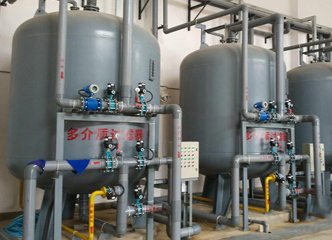
A well-engineered multimedia filter is a modular system designed for easy installation, operation, and maintenance. Its core components include:
Tank Body: The main container, available in cylindrical or rectangular shapes (based on space and capacity needs). Materials are selected by application: 316 stainless steel for chemical or marine environments; Q235 carbon steel for general industrial use (e.g., cooling water treatment).
Internal Filtration System:
Filter Material Layer: The heart of the filter, with 2~3 layers of media. For example: top layer (anthracite, 1.2~2.0 mm, light and coarse) traps large particles; middle layer (quartz sand, 0.5~1.2 mm) captures medium impurities; bottom layer (manganese sand, 0.6~1.0 mm, optional) removes iron and manganese (critical for urban tap water treatment).
Support Layer: A layer of gravel (2~4 mm) beneath the filter media, preventing media loss and ensuring uniform water distribution.
Water Distribution & Collection Systems: The water distribution system (e.g., perforated pipes, water caps) spreads raw water evenly over the filter media; the collection system (at the bottom) gathers clarified water, avoiding short-circuiting.
External Control & Monitoring:
Pipelines & Valves: Main inlet/outlet pipes, backwash inlet/outlet pipes, and control valves (manual or automated) for regulating flow.
Instruments: Pressure gauges (to monitor filter resistance and backwash timing), sampling valves (for on-site water quality testing), and optional flow meters (for tracking treatment capacity).
Tank Body: The main container, available in cylindrical or rectangular shapes (based on space and capacity needs). Materials are selected by application: 316 stainless steel for chemical or marine environments; Q235 carbon steel for general industrial use (e.g., cooling water treatment).
Internal Filtration System:
Filter Material Layer: The heart of the filter, with 2~3 layers of media. For example: top layer (anthracite, 1.2~2.0 mm, light and coarse) traps large particles; middle layer (quartz sand, 0.5~1.2 mm) captures medium impurities; bottom layer (manganese sand, 0.6~1.0 mm, optional) removes iron and manganese (critical for urban tap water treatment).
Support Layer: A layer of gravel (2~4 mm) beneath the filter media, preventing media loss and ensuring uniform water distribution.
Water Distribution & Collection Systems: The water distribution system (e.g., perforated pipes, water caps) spreads raw water evenly over the filter media; the collection system (at the bottom) gathers clarified water, avoiding short-circuiting.
External Control & Monitoring:
Pipelines & Valves: Main inlet/outlet pipes, backwash inlet/outlet pipes, and control valves (manual or automated) for regulating flow.
Instruments: Pressure gauges (to monitor filter resistance and backwash timing), sampling valves (for on-site water quality testing), and optional flow meters (for tracking treatment capacity).
Working Principle
The multimedia filter operates on the principle of depth filtration—a step-by-step trapping process that maximizes impurity removal while extending media life. Here’s how it works in industrial settings:
- Raw Water Inlet: High-turbidity raw water (e.g., from rivers, industrial wastewater, or cooling towers) is pumped into the filter tank under controlled pressure (typically 0.2~0.6 MPa).
- Layered Filtration: As water flows downward through the media layers:
- The top anthracite layer (coarse, light) first traps large suspended solids (e.g., sediment in raw water, fiber fragments in paper mill wastewater), preventing clogging of finer media below.
- The middle quartz sand layer (medium grain) captures smaller colloids and fine particles (e.g., oil droplets in degreasing processes), reducing turbidity significantly.
- The optional manganese sand layer (bottom) oxidizes and removes iron/manganese ions (common in groundwater used for irrigation or urban tap water), improving water taste and preventing pipe scaling.
- Clarified Water Outlet: After passing through all layers, clarified water (suspended solids <5 mg/L, turbidity <3 NTU) is collected by the bottom water system and sent to downstream processes—such as softeners (for boiler water) or RO units (for pure water production).
- Backwashing (Regeneration): When the filter’s pressure difference exceeds 0.15 MPa (indicating media clogging), the system initiates backwashing: clean water is pumped upward through the media, lifting and agitating it to flush out trapped impurities. The wastewater is discharged, and the filter resumes normal operation.


Application
The multimedia filter’s versatility makes it a staple in nearly every industrial sector where water quality matters. Key applications include:
- Power Industry: Pre-treatment of cooling water for thermal power plants—removing sediment and suspended solids to prevent scaling in heat exchangers, which improves energy efficiency by 10~15%.
- Food & Beverage Processing: Treatment of raw water for beverage production or dairy processing—ensuring suspended solids are removed to meet food safety standards (e.g., FDA requirements) and avoid affecting product taste.
- Paper Industry: Filtration of process water (e.g., for pulp washing)—trapping fiber fragments and ink residues, reducing water waste and improving paper quality (e.g., reducing paper defects like spots).
- Urban Water Supply: Pre-treatment of tap water—removing turbidity and iron/manganese from groundwater or surface water, ensuring compliance with WHO drinking water guidelines.
- Irrigation & Agriculture: Treatment of river or lake water for large-scale farm irrigation—removing sediment that could clog drip irrigation systems, saving maintenance costs for farmers.
- Chemical & Petrochemical Industry: Degreasing and pre-treatment of wastewater—removing oil droplets and suspended solids before further treatment, reducing the load on advanced systems (e.g., activated sludge units).
Summary
In industrial water treatment, the multimedia filter is more than a piece of equipment—it’s a cost-efficient, reliable solution that bridges the gap between raw water and high-quality process water. Its layered media design ensures superior filtration efficiency, while its durable build and easy maintenance minimize operational costs. From power plants to food factories, it adapts to diverse needs, delivering consistent water quality that protects equipment, complies with regulations, and supports sustainable production.
For businesses looking to optimize water treatment processes, reduce energy use, or meet strict quality standards, the multimedia filter is not just an option—it’s a necessity. Whether for pre-treatment, degreasing, or raw water clarification, it delivers performance you can trust, day in and day out.