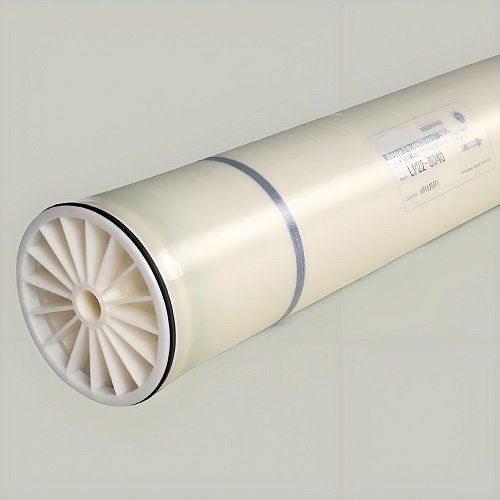
Product Introduction
The BW30-400 reverse osmosis (RO) membrane stands as a paragon of filtration technology, specifically designed to address the challenges of brackish water treatment. Manufactured by DuPont (formerly Dow FilmTec), this spiral-wound membrane leverages aromatic polyamide thin-film composite (TFC) technology to deliver the dual promise of >99.5% salt rejection and high water productivity—approximately 10,000 gallons per day (37.8 m³/d) under standard conditions. Engineered for municipal water systems, industrial process applications, and desalination pre-treatment, the BW30-400 balances robust performance with operational efficiency, setting a benchmark for RO membranes worldwide.
Working Principle
- Reverse Osmosis Mechanism
The BW30-400 operates on the principle of reverse osmosis, where hydraulic pressure overcomes the natural osmotic pressure to drive water through a semi-permeable membrane, rejecting dissolved solids and contaminants. Key operational mechanisms include:- Semi-Permeable Barrier: The polyamide active layer allows selective water passage while rejecting ions (e.g., Na⁺, Cl⁻), colloids, and organic molecules through size exclusion (pore size <0.0001 microns) and charge repulsion.
- Pressure-Driven Flow: Operating at 150–400 psi (1.0–2.8 MPa), the membrane forces water from the feed side to the permeate side, with salt rejection enhanced by the dense polyamide network.
- Osmotic Pressure Management: Higher salt concentrations in feed water require increased operating pressure to maintain flow, making pre-treatment critical for energy efficiency.
- Thin-Film Composite Architecture
- Active Layer: A cross-linked polyamide layer, formed via interfacial polymerization, provides the primary salt rejection capability and chemical resistance.
- Support Layer: A microporous polysulfone substrate offers structural integrity without compromising flow.
- Feed Spacer: A polypropylene mesh maintains turbulent flow in the feed channel, minimizing concentration polarization and fouling.
- Operational Parameters
- pH Stability: Functions effectively between pH 2–11, with short-term tolerance to pH 12 for cleaning protocols.
- Temperature Optimum: Peaks at 25°C, with performance declining ~1% per °C below this threshold; maximum allowable temperature is 45°C.
- Chlorine Sensitivity: Free chlorine exposure >0.1 ppm degrades the polyamide layer, necessitating pre-treatment with dechlorinators.
Structural Design and Engineering
- Spiral-Wound Module Configuration
- Membrane Leaf Construction: Multiple membrane leaves (active layer + support layer) are wound around a perforated central tube, forming a cylindrical element:
- Feed Channel: Axial flow through the spacer ensures uniform contact with the membrane surface.
- Permeate Collection: Purified water spirals into the central tube, minimizing pressure loss.
- Dimensions: 8-inch diameter x 40-inch length (203 mm x 1016 mm) with 400 ft² (37.2 m²) effective membrane area, optimizing space efficiency.
- Membrane Leaf Construction: Multiple membrane leaves (active layer + support layer) are wound around a perforated central tube, forming a cylindrical element:
- Material Science Innovations
- Polyamide Active Layer: Engineered for high cross-link density, enhancing salt rejection while maintaining hydrophilicity for improved water flux.
- GRP Pressure Vessel: Glass-reinforced polyester housing withstands up to 600 psi (4.1 MPa), with anti-UV coatings for outdoor installations.
- Anti-Fouling Surface: Modified surface chemistry reduces organic and inorganic adsorption, extending time between cleanings.
- Flow Dynamics Optimization
- Turbulence Induction: The feed spacer’s geometry promotes cross-flow velocity >1 m/s, reducing particulate deposition.
- Permeate Spacer Design: Minimizes channel restriction, ensuring uniform permeate collection.
Application Scenarios
- Municipal Water Systems
- Drinking Water Production: In regions with brackish groundwater, the BW30-400 reduces TDS from 1,500 ppm to <50 ppm. A case study in Saudi Arabia’s Al Khobar municipality showed the membrane reduced fluoride from 2.5 ppm to <1.0 ppm, meeting WHO guidelines.
- Water Recycling: Treats secondary wastewater effluent to non-potable standards, with COD removal >90% and turbidity <0.1 NTU for industrial reuse.
- Industrial Process Water
- Power Generation: Purifies boiler feed water, removing silica (<0.5 ppm) and dissolved solids to prevent heat exchanger scaling, saving 20% on chemical treatment costs in a 500 MW plant.
- Pharmaceutical Manufacturing: Produces water for injection (WFI) with conductivity <1.3 μS/cm, meeting USP standards for drug formulation.
- Desalination Pre-Treatment
- SWRO Pre-Filtration: Used ahead of seawater RO membranes, the BW30-400 reduces SDI (silt density index) from 5 to <3, extending seawater membrane life by 40% in a 10,000 m³/d desalination plant in Oman.
- Brackish Water Desalination: Achieves 85% recovery in brackish water systems, with energy consumption as low as 0.8 kWh/m³.
Technical Advantages
- Superior Salt Rejection
- Maintains >99.5% NaCl rejection at 200 psi (1.4 MPa), outperforming cellulose triacetate membranes by 15% in divalent ion removal (e.g., Ca²⁺, Mg²⁺).
- High Flux Efficiency
- Delivers 26 gpd/ft² (10.2 L/m²·h) at standard conditions, 30% higher than legacy RO membranes, enabling 20% smaller system footprints.
- Operational Flexibility
- Adapts to varying feed water qualities, with proven performance in waters ranging from 500–10,000 ppm TDS.
- Tolerates short-term upsets in feed water chemistry, such as sudden pH shifts or turbidity spikes.
- Cost-Effective Longevity
- With proper pre-treatment, operates for 4–6 years, reducing lifecycle costs by 25% compared to lower-performance membranes. A food processing plant in California reported $120,000 in savings over a 5-year period.
Maintenance and Operational Best Practices
- Comprehensive Pre-Treatment
- Particle Filtration: 5-micron cartridge filters remove suspended solids to prevent membrane abrasion and channel blockage.
- Chlorine Scavenging: Sodium bisulfite dosing (3–5 ppm) reduces free chlorine to <0.05 ppm, verified by ORP sensors.
- Scale Inhibition: Polyphosphate anti-scalants (2–5 ppm) prevent calcium sulfate scaling at recovery rates >75%.
- Proactive Cleaning Protocols
- Cleaning Triggers: Initiate when pressure drop increases by 15%, flow decreases by 10%, or salt rejection declines by 5%.
- Chemical Cleaning Formulations:
- Organic Fouling: 2% citric acid + 0.1% SDS at pH 3–4 for 60 minutes.
- Biofouling: 0.5% sodium hypochlorite at pH 10 for 30 minutes, followed by citric acid rinse.
- Cleaning Frequency: Every 4–8 months in typical brackish water applications, extending to 12 months with advanced pre-treatment.
- Operational Optimization
- Recovery Control: Maintain <80% recovery for waters with >3,000 ppm TDS to avoid concentrate scaling.
- Temperature Compensation: Adjust pressure by 3 psi/°C (0.02 MPa/°C) to maintain constant flux in seasonal temperature variations.
Conclusion
The BW30-400 reverse osmosis membrane exemplifies the pinnacle of RO technology, combining exceptional salt rejection, high water productivity, and operational resilience. Its thin-film composite architecture and spiral-wound design make it indispensable in water-scarce regions and industries demanding high-purity water. As global water challenges intensify, the BW30-400’s role in sustainable water management—through efficient brackish water treatment and water recycling—will only grow. Future innovations, such as nanocomposite membrane coatings and AI-driven predictive maintenance, promise to further enhance its efficiency and durability, solidifying its status as a cornerstone of modern water purification.
If you are interested in this product or have any questions, please feel free to contact us at any time.