Introduce:
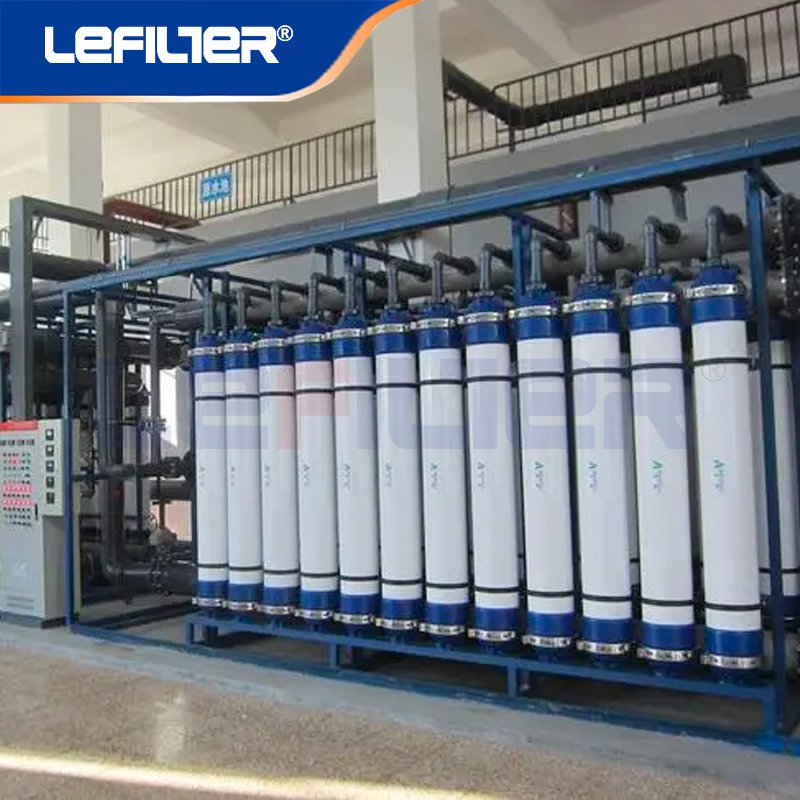
In the landscape of modern separation and purification technology, ultrafiltration (UF) equipment stands out as a versatile, high-efficiency solution that bridges the gap between traditional filtration and advanced membrane processes. At its core, UF equipment leverages ultrafiltration membrane fibers as the filtering medium, using pressure differentials to separate solvents (like water molecules) and small molecules (inorganic salts, tiny organics) from larger contaminants. Unlike coarser filters, it targets suspended solids, colloids, proteins, and microorganisms with precision, making it a linchpin in industries where clarity, purity, and consistency are non-negotiable—from water treatment to pharmaceutical manufacturing. As global demand for sustainable, energy-efficient purification grows, UF equipment has emerged as a reliable workhorse, delivering results without compromising on performance or environmental impact.
Advantages & Features
2.1 Exceptional Filtration Precision
UF equipment boasts a filtration accuracy range of 0.005–0.01μm—fine enough to trap even microscopic particles, bacteria, heat sources, and macromolecular organics while letting water and small molecules pass freely. This level of precision ensures purified streams meet strict quality standards, eliminating the need for additional chemical treatments in many cases.
2.2 Energy Efficiency & Gentle Operation
A key advantage of UF is its reliance on pressure (not heat) as a driving force, and its ability to operate at room temperature (no phase inversion required). This not only cuts energy consumption compared to thermal separation methods but also makes it ideal for heat-sensitive substances—such as pharmaceuticals, dairy products, or biological fluids—where high temperatures would damage valuable compounds.
2.3 Robust Performance Across Conditions
UF equipment is built to withstand harsh environments: it maintains stability at temperatures below 60°C and a pH range of 2–11, with excellent resistance to acids, alkalis, and oxidation. This durability allows continuous, long-term operation (often 24/7 in industrial settings) without frequent component replacement, reducing downtime and maintenance costs.
2.4 Sustainable & Eco-Friendly
With minimal chemical usage (unlike some water treatment processes that rely on coagulants or disinfectants), UF equipment reduces environmental footprint. It also generates less waste, as membrane systems can be cleaned and reused, and its ability to recover valuable materials (e.g., proteins in food processing) further enhances sustainability.
2.5 Scalability & Flexibility
UF systems are modular by design, meaning they can be scaled up for large industrial plants (e.g., municipal water treatment) or downsized for small-scale applications (e.g., laboratory purification). They also adapt to diverse feed streams—from brackish water to industrial wastewater—making them a one-stop solution for multiple sectors.
UF equipment boasts a filtration accuracy range of 0.005–0.01μm—fine enough to trap even microscopic particles, bacteria, heat sources, and macromolecular organics while letting water and small molecules pass freely. This level of precision ensures purified streams meet strict quality standards, eliminating the need for additional chemical treatments in many cases.
2.2 Energy Efficiency & Gentle Operation
A key advantage of UF is its reliance on pressure (not heat) as a driving force, and its ability to operate at room temperature (no phase inversion required). This not only cuts energy consumption compared to thermal separation methods but also makes it ideal for heat-sensitive substances—such as pharmaceuticals, dairy products, or biological fluids—where high temperatures would damage valuable compounds.
2.3 Robust Performance Across Conditions
UF equipment is built to withstand harsh environments: it maintains stability at temperatures below 60°C and a pH range of 2–11, with excellent resistance to acids, alkalis, and oxidation. This durability allows continuous, long-term operation (often 24/7 in industrial settings) without frequent component replacement, reducing downtime and maintenance costs.
2.4 Sustainable & Eco-Friendly
With minimal chemical usage (unlike some water treatment processes that rely on coagulants or disinfectants), UF equipment reduces environmental footprint. It also generates less waste, as membrane systems can be cleaned and reused, and its ability to recover valuable materials (e.g., proteins in food processing) further enhances sustainability.
2.5 Scalability & Flexibility
UF systems are modular by design, meaning they can be scaled up for large industrial plants (e.g., municipal water treatment) or downsized for small-scale applications (e.g., laboratory purification). They also adapt to diverse feed streams—from brackish water to industrial wastewater—making them a one-stop solution for multiple sectors.

Structure Specification
UF equipment consists of coordinated components that work together to ensure seamless separation. Here’s a breakdown of its key parts:
3.1 Ultrafiltration Membrane Module
The heart of the system, this module houses hundreds to thousands of ultrafiltration membrane fibers (typically made of polyethersulfone, polysulfone, or PVDF—materials chosen for their durability and filtration efficiency). The fibers are arranged in bundles, with hollow or solid structures that create channels for feed fluid and purified permeate. Membrane modules come in configurations like hollow fiber, flat sheet, or tubular, tailored to specific flow rates and contamination levels.
3.2 Pressure System
A low-to-moderate pressure pump (usually 0.1–0.3MPa) provides the driving force to push feed fluid through the membrane fibers. The pressure is carefully calibrated to balance filtration speed and membrane protection—high enough to ensure efficient separation, but not so high that it damages the membrane’s delicate pores.
3.3 Feed & Permeate Distribution System
This includes pipes, valves, and manifolds that direct the feed fluid into the membrane module and channel the purified permeate (solvent + small molecules) out for use or further processing. It also manages the “concentrate” stream—fluid rich in retained contaminants—which is either recycled (for maximum recovery) or discharged.
3.4 Cleaning & Control Unit
To prevent membrane fouling (buildup of contaminants on the membrane surface), UF equipment includes a cleaning system (backwashing with water or chemical cleaning solutions) that maintains flux and efficiency. A digital control panel monitors pressure, flow rate, and temperature, with automated alerts to signal when cleaning or maintenance is needed.
3.1 Ultrafiltration Membrane Module
The heart of the system, this module houses hundreds to thousands of ultrafiltration membrane fibers (typically made of polyethersulfone, polysulfone, or PVDF—materials chosen for their durability and filtration efficiency). The fibers are arranged in bundles, with hollow or solid structures that create channels for feed fluid and purified permeate. Membrane modules come in configurations like hollow fiber, flat sheet, or tubular, tailored to specific flow rates and contamination levels.
3.2 Pressure System
A low-to-moderate pressure pump (usually 0.1–0.3MPa) provides the driving force to push feed fluid through the membrane fibers. The pressure is carefully calibrated to balance filtration speed and membrane protection—high enough to ensure efficient separation, but not so high that it damages the membrane’s delicate pores.
3.3 Feed & Permeate Distribution System
This includes pipes, valves, and manifolds that direct the feed fluid into the membrane module and channel the purified permeate (solvent + small molecules) out for use or further processing. It also manages the “concentrate” stream—fluid rich in retained contaminants—which is either recycled (for maximum recovery) or discharged.
3.4 Cleaning & Control Unit
To prevent membrane fouling (buildup of contaminants on the membrane surface), UF equipment includes a cleaning system (backwashing with water or chemical cleaning solutions) that maintains flux and efficiency. A digital control panel monitors pressure, flow rate, and temperature, with automated alerts to signal when cleaning or maintenance is needed.
Working Principle
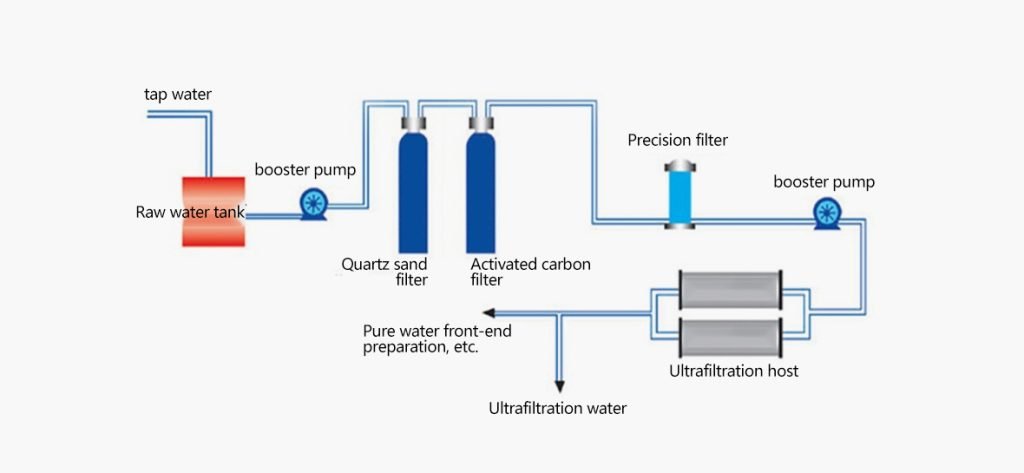
Ultrafiltration operates on a sieving mechanism driven by pressure, following these key steps:
Feed Preparation (Optional): For feed streams with high levels of large particles (e.g., raw wastewater), a pre-filtration step (e.g., 5–10μm sediment filters) may be used to protect the UF membrane from clogging.
Pressurization: The feed fluid is pumped into the membrane module at a controlled pressure. This pressure creates a differential between the “feed side” (inside or outside the membrane fibers) and the “permeate side,” forcing the fluid toward the membrane.
Membrane Separation: As the feed fluid contacts the membrane fibers, small molecules (water, inorganic salts, tiny organics) pass through the 0.005–0.01μm pores into the permeate channel. Larger contaminants—suspended solids, colloids, bacteria, proteins—are too big to fit through the pores and are retained on the feed side, forming the concentrate stream.
Permeate Collection & Concentrate Management: The purified permeate is collected and sent for use (e.g., drinking water, industrial process water) or further treatment (e.g., reverse osmosis pretreatment). The concentrate, now concentrated with contaminants, is either recycled back into the feed (for higher recovery) or disposed of safely.
Membrane Maintenance: Periodic backwashing (reversing the flow of permeate) or chemical cleaning removes fouled contaminants, restoring the membrane’s flux and ensuring consistent performance.
Feed Preparation (Optional): For feed streams with high levels of large particles (e.g., raw wastewater), a pre-filtration step (e.g., 5–10μm sediment filters) may be used to protect the UF membrane from clogging.
Pressurization: The feed fluid is pumped into the membrane module at a controlled pressure. This pressure creates a differential between the “feed side” (inside or outside the membrane fibers) and the “permeate side,” forcing the fluid toward the membrane.
Membrane Separation: As the feed fluid contacts the membrane fibers, small molecules (water, inorganic salts, tiny organics) pass through the 0.005–0.01μm pores into the permeate channel. Larger contaminants—suspended solids, colloids, bacteria, proteins—are too big to fit through the pores and are retained on the feed side, forming the concentrate stream.
Permeate Collection & Concentrate Management: The purified permeate is collected and sent for use (e.g., drinking water, industrial process water) or further treatment (e.g., reverse osmosis pretreatment). The concentrate, now concentrated with contaminants, is either recycled back into the feed (for higher recovery) or disposed of safely.
Membrane Maintenance: Periodic backwashing (reversing the flow of permeate) or chemical cleaning removes fouled contaminants, restoring the membrane’s flux and ensuring consistent performance.
Application
UF equipment’s versatility makes it indispensable across diverse industries, with key uses including:
5.1 Reverse Osmosis (RO) Pretreatment
RO membranes are highly sensitive to colloids and bacteria—even tiny particles can damage them or reduce efficiency. UF equipment acts as a “guardian,” removing these contaminants from feed water before it enters the RO system. This extends RO membrane lifespan by 30–50% and improves RO’s desalination performance, making it critical in seawater/brackish water desalination plants.
5.2 Drinking Water Treatment
In municipal and residential settings, UF equipment purifies surface water or groundwater by removing bacteria (e.g., E. coli), viruses, and turbidity-causing colloids. It produces safe, clear drinking water without the need for chlorine (or with reduced chlorine use), eliminating the risk of disinfection byproducts—ideal for communities prioritizing chemical-free purification.
5.3 Reclaimed Water Reuse
As water scarcity worsens, UF equipment plays a key role in recycling wastewater (e.g., municipal sewage, industrial effluent). It treats wastewater to a level suitable for non-potable uses like irrigation, industrial cooling, or toilet flushing, conserving freshwater resources. In some cases, UF-treated reclaimed water can even be further purified for potable reuse.
5.4 Industrial & Specialty Applications
Pharmaceuticals: UF equipment separates and concentrates proteins, enzymes, and antibodies in drug manufacturing, ensuring product purity and potency. It also removes bacteria and heat sources from injectable solutions, meeting strict FDA standards.
Food & Beverage: It clarifies fruit juices (removing pulp and colloids), concentrates milk proteins (for cheese or yogurt production), and purifies brewing water—enhancing product quality and shelf life.
Electronics: UF-treated water is used in semiconductor manufacturing to remove tiny particles that could damage microchips, ensuring precision in electronic components.
5.1 Reverse Osmosis (RO) Pretreatment
RO membranes are highly sensitive to colloids and bacteria—even tiny particles can damage them or reduce efficiency. UF equipment acts as a “guardian,” removing these contaminants from feed water before it enters the RO system. This extends RO membrane lifespan by 30–50% and improves RO’s desalination performance, making it critical in seawater/brackish water desalination plants.
5.2 Drinking Water Treatment
In municipal and residential settings, UF equipment purifies surface water or groundwater by removing bacteria (e.g., E. coli), viruses, and turbidity-causing colloids. It produces safe, clear drinking water without the need for chlorine (or with reduced chlorine use), eliminating the risk of disinfection byproducts—ideal for communities prioritizing chemical-free purification.
5.3 Reclaimed Water Reuse
As water scarcity worsens, UF equipment plays a key role in recycling wastewater (e.g., municipal sewage, industrial effluent). It treats wastewater to a level suitable for non-potable uses like irrigation, industrial cooling, or toilet flushing, conserving freshwater resources. In some cases, UF-treated reclaimed water can even be further purified for potable reuse.
5.4 Industrial & Specialty Applications
Pharmaceuticals: UF equipment separates and concentrates proteins, enzymes, and antibodies in drug manufacturing, ensuring product purity and potency. It also removes bacteria and heat sources from injectable solutions, meeting strict FDA standards.
Food & Beverage: It clarifies fruit juices (removing pulp and colloids), concentrates milk proteins (for cheese or yogurt production), and purifies brewing water—enhancing product quality and shelf life.
Electronics: UF-treated water is used in semiconductor manufacturing to remove tiny particles that could damage microchips, ensuring precision in electronic components.
Summary
Ultrafiltration equipment is more than just a filtration tool—it’s a versatile, sustainable solution that redefines how we purify and separate fluids across industries. With its exceptional precision, energy efficiency, and robustness, it addresses critical challenges: protecting delicate RO membranes, delivering safe drinking water, conserving freshwater via reuse, and ensuring purity in sensitive sectors like pharmaceuticals. Its ability to operate at room temperature and resist harsh conditions makes it a cost-effective, low-maintenance choice for long-term use. As the world continues to prioritize clean water and sustainable manufacturing, UF equipment will only grow in importance—solidifying its role as a cornerstone of modern membrane technology. Whether in a municipal water plant, a pharmaceutical lab, or a food factory, UF equipment delivers consistent, reliable results that empower industries to operate cleaner, more efficiently, and more responsibly.