Introduce:
In the realm of water treatment, high-flow cartridge filters have emerged as a transformative solution, particularly in reverse osmosis (RO) pretreatment and large-scale filtration applications. Designed to handle substantial water volumes efficiently, these filters address critical challenges in industrial water processing, where both performance and cost-effectiveness are paramount.
The R0 reverse osmosis pretreatment high-flow filter element, a standout in this category, redefines efficiency by outperforming traditional 2.5-inch filter elements. Its ability to process up to 30 tons per hour (T/h) per element eliminates the need for excessive filter quantities, reducing both equipment footprint and initial investment. As industries increasingly prioritize streamlined operations and cost reduction, high-flow cartridge filters have become indispensable in ensuring consistent water quality while optimizing resource usage.
Advantages & Features
2.1 Exceptional Flow Capacity
Each R0 high-flow filter element delivers a remarkable 30 T/h processing rate, far exceeding the capacity of standard 2.5-inch elements. This high throughput minimizes the number of elements required for large-scale operations—for instance, a 300 T/h system would need just 10 R0 elements, compared to dozens of smaller filters. This reduction simplifies system design and enhances operational efficiency.
2.2 Cost Reduction
By cutting the number of filter elements and shrinking filter housing size, these filters significantly lower upfront investment. Reduced housing dimensions also save valuable floor space, a critical advantage in compact industrial facilities. Long-term savings accrue from fewer replacements and lower labor costs associated with maintenance.
2.3 Easy Maintenance
The horizontal design and centerless structure of high-flow filter systems streamline element replacement. Unlike traditional filters requiring cumbersome disassembly, these systems allow quick, tool-free changes, minimizing downtime—a key benefit for industries where continuous operation is vital, such as power generation or semiconductor manufacturing.
2.4 Broad Contaminant Removal
Engineered to target a wide range of impurities, including suspended solids, particulates, scale, bacteria, algae, and rust, these filters ensure thorough pretreatment. This versatility eliminates the need for multiple specialized filters, simplifying water treatment chains.
dissolved salts (including sodium ions, chloride ions, calcium and magnesium ions, etc.), organic matter (such as pesticides, petrochemical products, etc.), colloids, microorganisms (bacteria, viruses, etc.), are intercepted.
Structure Specification
3.1 Filter Element Design
High-flow cartridge filters feature a robust, elongated structure optimized for maximum surface area. The R0 element, for example, typically has a larger diameter than standard filters, allowing greater water contact with the filter media. This design enhances contaminant capture without sacrificing flow rate.
3.2 Filter Media
The media is carefully selected for durability and efficiency, often consisting of pleated polypropylene, glass fiber, or composite materials. These materials offer high dirt-holding capacity, ensuring prolonged service life even in high-contaminant environments. The media’s porous structure traps particles as small as 1–5 microns, depending on application needs.
3.3 Housing & System Integration
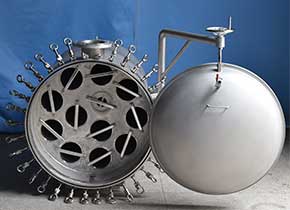
Filter housings are engineered to accommodate large elements, with horizontal configurations that facilitate even flow distribution. Made from corrosion-resistant materials like stainless steel or reinforced plastic, they withstand high pressures (typically 100–150 psi) and harsh industrial conditions. The centerless design eliminates central support structures, simplifying element insertion and removal.
3.4 Sealing & Flow Distribution
Precision-molded end caps ensure tight seals, preventing bypass and ensuring all water passes through the filter media. Internal flow channels are optimized to minimize pressure drop, maintaining high flow rates even as the filter accumulates contaminants.
Working Principle
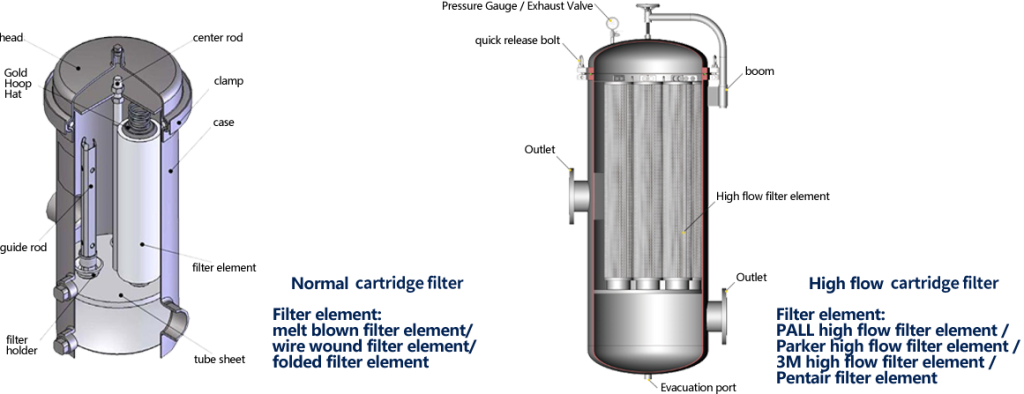
High-flow cartridge filters operate on a pressure-driven mechanism, leveraging differential pressure to push raw water through the filter element. As water enters the housing, it flows around the exterior of the cartridge and is forced through the porous media. Contaminants—including suspended solids, bacteria, and rust—are trapped on the media’s surface or within its matrix, while filtered water passes through the element’s core and exits through the housing outlet.
A key design advantage is the system’s ability to utilize each large-flow element to its full potential. Unlike standard filters, which often suffer from uneven flow distribution, high-flow systems’ horizontal layout ensures uniform water contact with the media, maximizing filtration efficiency. When pressure drop across the element reaches a threshold (typically 10–15 psi), indicating media saturation, the element is replaced—facilitated by the centerless design for quick, hassle-free maintenance.
Application
5.1 Reverse Osmosis Pretreatment
As a critical pre-filter for RO systems, high-flow cartridges protect delicate RO membranes from fouling by removing suspended solids, scale, and bacteria. This extends membrane life, reduces cleaning frequency, and maintains RO efficiency—essential in industries like desalination, where membrane replacement costs are significant.
5.2 Municipal Water Treatment
In municipal plants, these filters pretreat surface water or groundwater, removing sediments and particulates before disinfection. Their high flow capacity makes them ideal for processing large volumes of water for urban supply networks.
5.3 Industrial Process Water
Industries such as food and beverage, pharmaceuticals, and electronics rely on high-flow filters to purify process water. In beverage production, for example, they remove algae and particulates to ensure product clarity and safety. In semiconductor manufacturing, they deliver ultra-clean water to prevent microchip contamination.
5.4 Power Generation
Power plants use high-flow filters to treat cooling tower water and boiler feedwater, removing rust and scale-forming particles. This prevents equipment corrosion and scaling, ensuring efficient turbine and boiler operation.
5.5 Wastewater Reclamation
In wastewater reuse systems, these filters play a vital role in pretreating effluent, removing suspended solids and organic matter before advanced treatment (e.g., UV disinfection or ion exchange). This enables safe water recycling for non-potable uses like irrigation or industrial washing.
By combining high performance, cost efficiency, and ease of maintenance, high-flow cartridge filters have become a cornerstone of modern industrial water treatment, ensuring reliable operation across diverse applications.